Off Topic – Grilled Corn with Shadon Beni Butter

Grill Corn and Brats

Direct Grilled Corn (with Brats)

In my humble opinion, there’s only one way to grill corn – out of the husk and directly over the coals (not gas – that ain’t even real grilling).  Now I know a lot of folks, including some very close friends, like to leave the husks on their corn when they grill it.  I don’t know, something about sealing in the juices.  But the fact is, corn has plenty of water and it’s not like direct grilling it dries it out.  Quite the contrary.

Grilling in the husks is basically just steam cooking using heat from the grill.  Direct grilling accomplishes something important that steaming doesn’t.  When you direct grill corn, the sugars in the water caramelize, resulting in an extraordinary sweetness that is accented by a touch of smoky goodness.  Trust me, nothing else compares.

Direct grilling corn is easy.  Grill it just like a hot dog, turn it frequently to make sure it cooks evenly.  You can tell when it’s ready by the color change and the light charring as shown in the photo.  You can top with butter, salt and pepper, but if you really want to impress, mix up some Shadon Beni butter (preferably in advance, it’ll keep all summer):

  • 8 tablespoons (1 stick) butter (room temperature)
  • 3 tablespoons finely chopped fresh cilantro
  • 2 scallions, both white and green parts, trimmed and minced
  • 1 clove garlic, minced
  • salt and pepper to taste.

Spread this on your grilled corn and then spritz it with some fresh lime juice, and I guarandamntee you’ll wish you had grilled more.  Please trust me on this; you’ll never want corn cooked and served any other way ever again.

***

Thoughts on the Art of Restoration

10-Gauge-stock-&-receiver-right-Comp-1

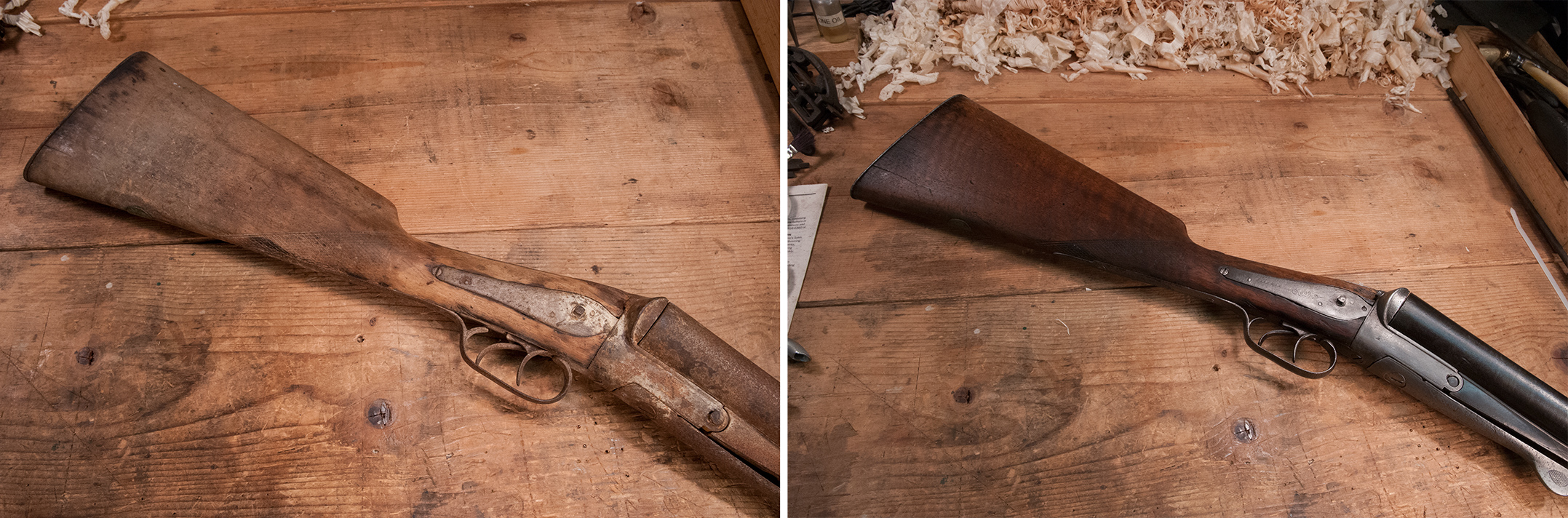
There are definitely artistic elements to restoration, and while mostly technical, I would argue that compositional elements also come into play in an unconventional sense. It’s very much like creating something with found objects. I approach restoration projects with the objective of finding the fine, although often fuzzy, line between age and damage, removing the latter while keeping the former. Instead of graphite, ink, or paint, the media used here were a variety of abrasives, lubricants, and chemicals that effect specific desired changes in metal and wood.

***

Japanese Arisaka Restoration

The recent successful completion of the Lee-Enfield restoration has me inspired to work on a couple of other neglected firearms that have been in the family for decades.

My dad was in the navy in WWII and brought home a Japanese Arisaka rifle from the Philippines.  He never talked much about the war, and all he had to say about the rifle was that there was a pile of them that were free for the taking.  So, he brought one home.  Fortunately, he never tried to shoot it; more on that in a moment.

1930s-40s Japanese Arisaka before restoration (bolt removed)

1930s-40s Japanese Arisaka before restoration (bolt removed)

The rifle was stored in our attic from the time the house was built in the late 1950s until 1983, when my mother moved closer to town.  It went straight into that attic until 2006, when she moved into a retirement facility.  Unbeknownst to my brother and me, she gave it to a family friend.  Since each of us thought the other had it, the rifle never came up in conversation until last summer, when I happened to ask about it.  Long story short, the family friend graciously returned it to us, along with a side by side shotgun that is in horrendous condition.

I don’t know the rifle’s condition when my dad picked it up in the Philippines, but having spent 70 years in attics since, the Arisaka accumulated a lot of dust and rust.  The wood was in fair condition, but very dry; all the metal surfaces were rusty and most of the original bluing was gone.

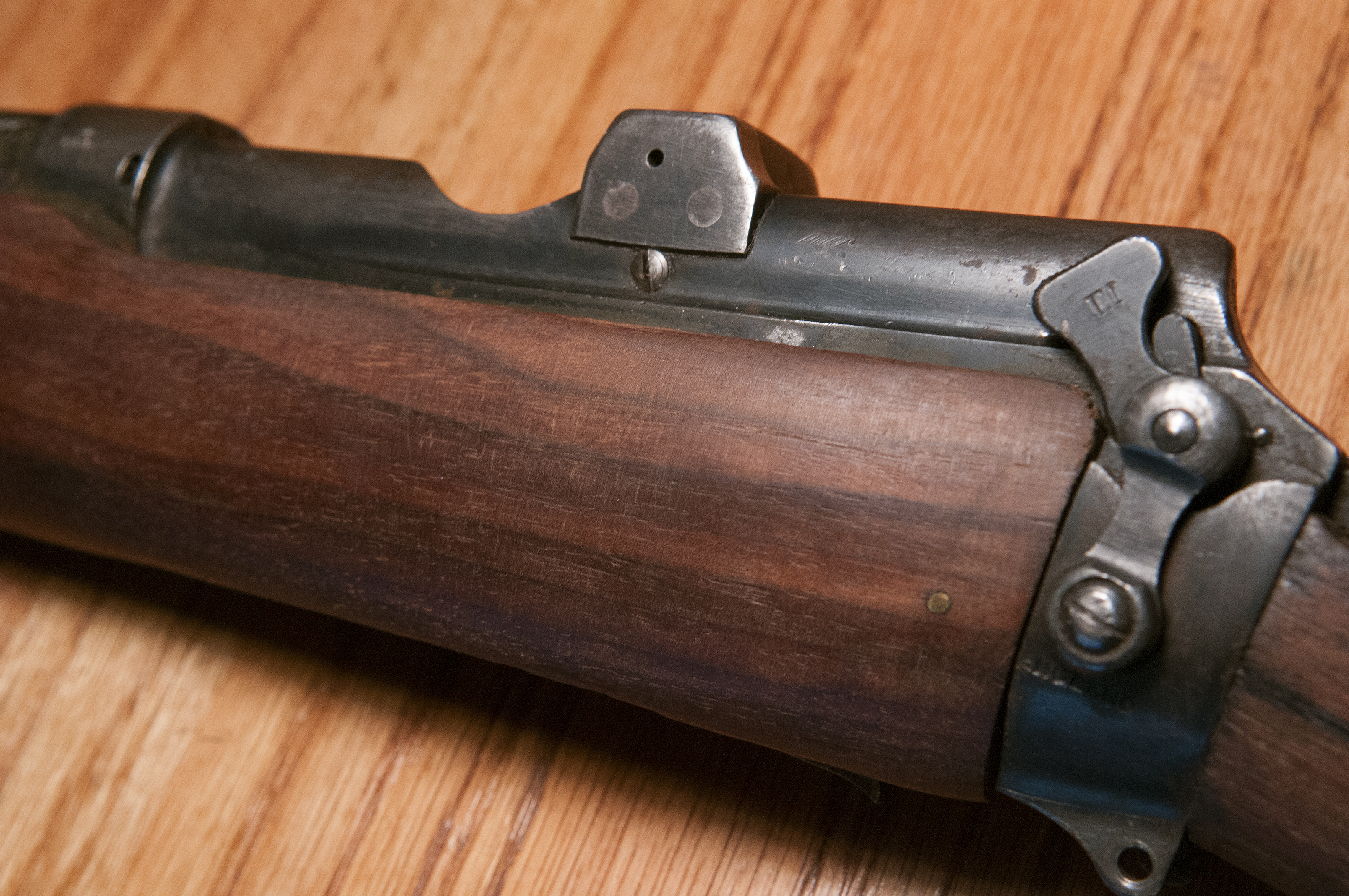
Detail of the receiver and rear sight

Detail of the receiver and rear sight

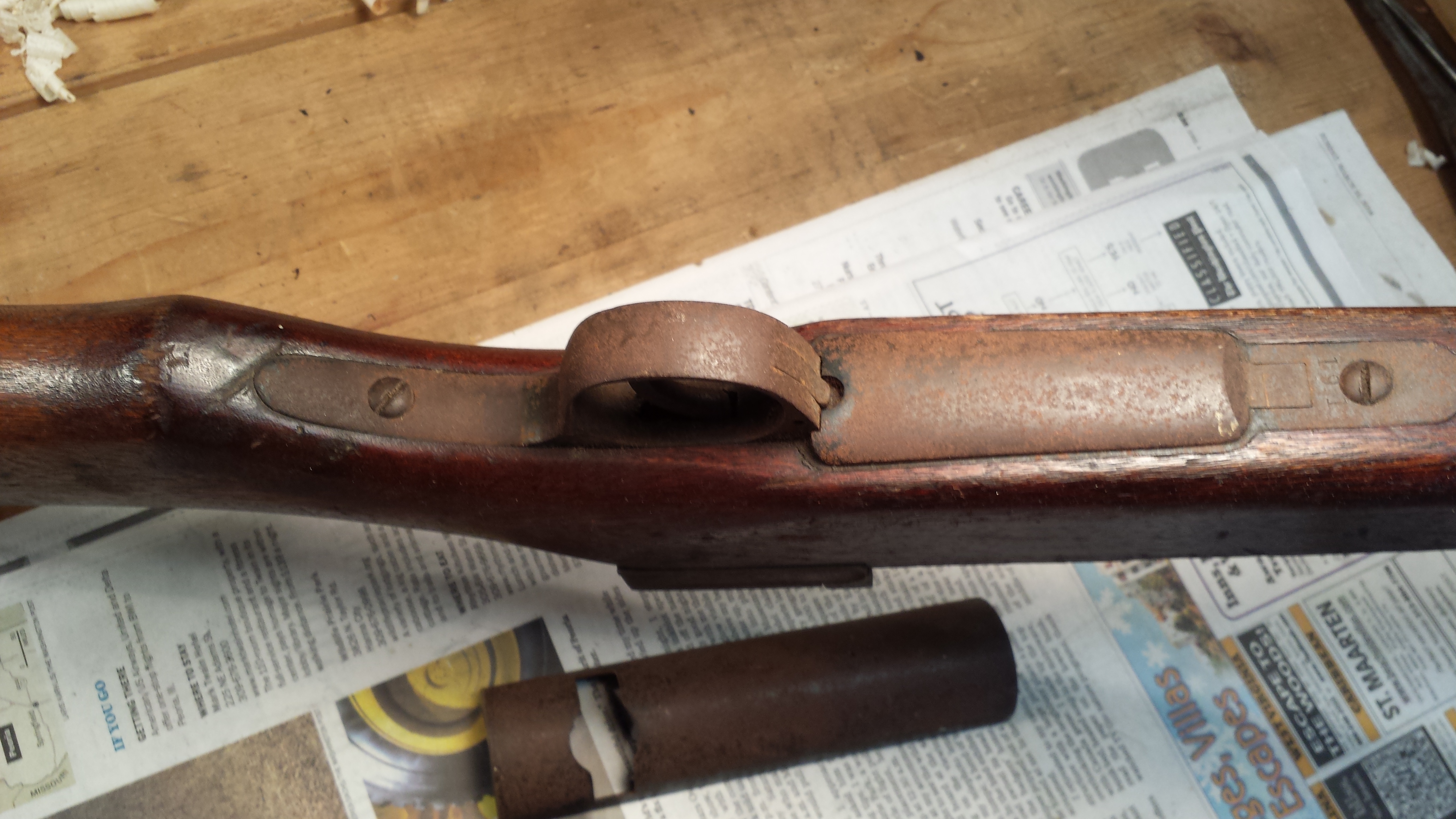
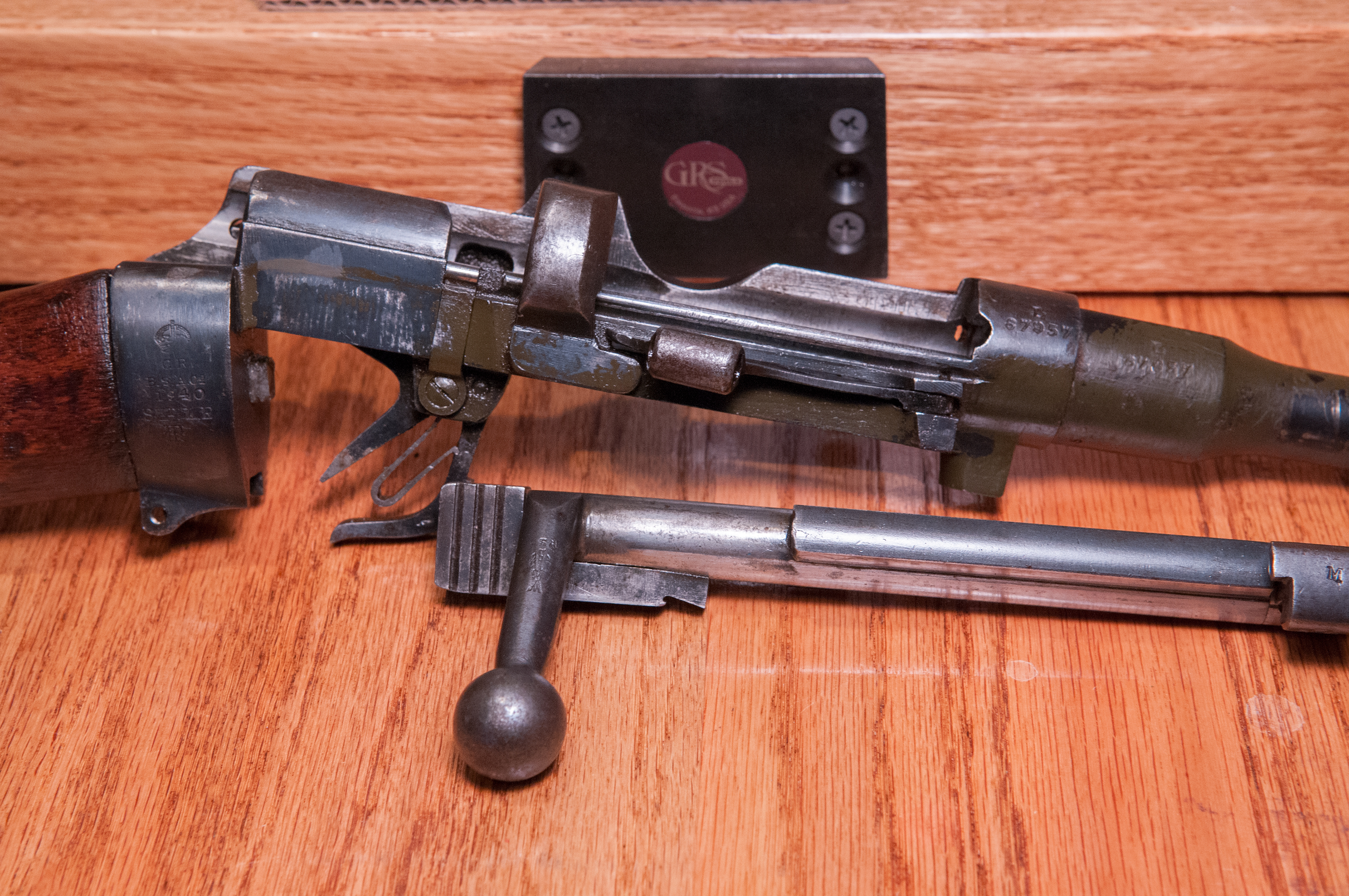
After doing some research, I’m 90% sure this particular Arisaka was strictly a training rifle, and was never shootable. It appears to be some sort of type 38/type 99 hybrid with a mixture of parts from both designs. The biggest giveaways are lack of a serial number and proper hallmarks, and the fact that the barrel isn’t rifled. It is interesting, however, that it does seem to have all the correct mechanical parts of a fully functional rifle, including the firing pin, magazine spring, and the action dust cover, which is normally missing from all Arisakas. That one part, seen in the photo below, is probably worth as much as the rest of the rifle.

Detail of the bottom, trigger guard and magazine floor plate

Detail of the bottom, trigger guard and magazine floor plate

These training rifles are not uncommon, but they were not constructed to handle live ammo and are likely to explode if shot. The receivers were made of cast iron and intended for either wooden rounds or low power blanks.  Because they are virtually indistinguishable from the real rifles, a lot of GIs who brought them home after the war tried to shoot them. The consequence of doing this was not pretty.  This earned the later Arisakas a reputation for being poorly made and these are sometimes (incorrectly) referred to as Last Ditch guns.

Since I didn’t have to worry about shooting it or compromising its value (it’s a $50-$100 gun at best), the restoration focused primarily on the cosmetic, with mechanical function a secondary concern.  Fortunately, none of the screws were seized and the rifle disassembled quickly.  Compared to the Enfield, taking this one apart was a breeze.  The rust turned out to be mainly superficial, and came off pretty easily with some CLP and light brushing.  The receiver and barrel required a little more aggressive scrubbing with the CLP and steel wool, but cleaned up very nicely.

Arisaka-Comp-5Once cleaned and degreased, I used a cold blue oxidizing agent to darken the metal areas that were overly brightened by the cleaning.  This toned it down to a perfect match to the overall patina of this 70-year-old firearm.  With a little light surface toning, the result was a rich and lustrous dark blue/gray finish that accurately reflects the age and matches the remaining patina.

Arisaka receiver before & after restoration

Arisaka receiver before & after restoration

The stock, as I said, was overall pretty good, but the wood was very dry and splintery, and there were a lot of scratches and dings from laying bare in attics, etc.  A few applications of Kramer’s Best had it looking much better, but I still wasn’t satisfied with the result.  After looking at it and thinking about it for a few days, I decided to give it a light application of Watco Danish Oil, which is thin and penetrates well, and is great stuff overall.  Unlike many finishes, it builds up very slowly with a low sheen, and plays nice with other existing finishes in my experience.  I used a mahogany tint that matched the original finish on the rifle, and gave it just a single application.  The result was a remarkable improvement.  Scratches faded, tone evened out, and the overall surface just felt better in the hand.

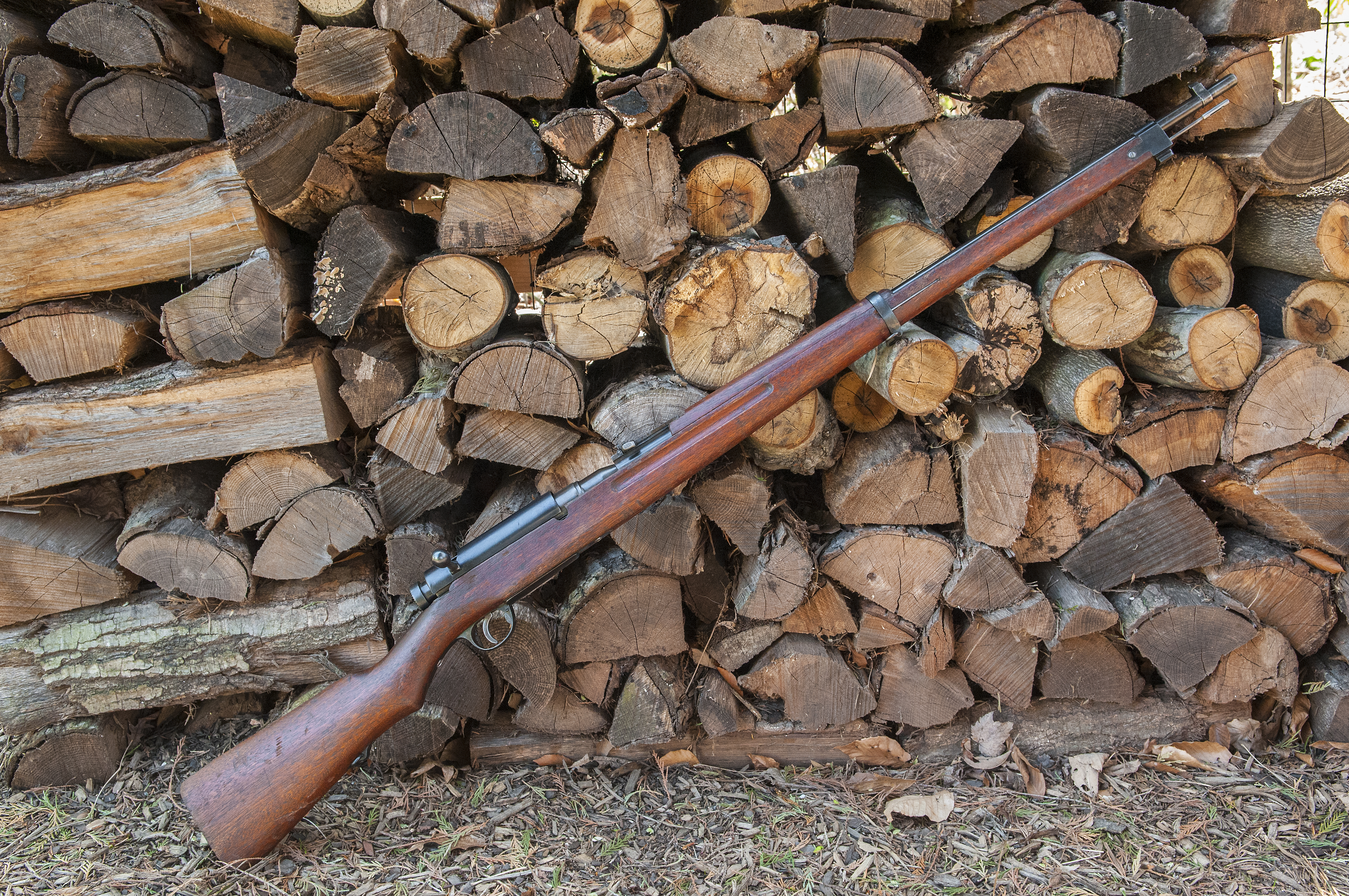
Reassembled, the rifle looks great.  Since it’s not shootable, it will never be anything other than a wall hanger, but that’s okay.  It’s a piece of history and a link to my dad.

Arisaka after restoration

Arisaka after restoration

Cutting Grass

Author’s Note: Please excuse and indulge this divergence from the topic at hand, although it is in fact tool related. I wrote this essay about 12 years ago and came across it tonight. Given the time of year, I thought it timely. It brings back some fond memories of my own boys, and also reminds me of a certain nephew of mine who loves to cut grass…
lawn-clippings
I’ve been cutting grass for as long as I can remember.  I guess I must have been about 8 years old when my dad finally consented to let me drive the “riding mower.”  It was a red Toro with white trim, not large or powerful, but to an 8 year old boy it might just as well have been a mammoth John Deere tractor.  By this age, I had some minor experience with the push mower, a white Briggs and Stratton motor with a hole in the muffler, bolted to the top of a nondescript gray chassis.  No bag attachment or height adjustment or self-propelled feature in those days.  It had a large semi-circular hole in the upper left side of the mower deck, the product of a violent altercation with large tree root in my grandmother’s yard, which my mother failed to address with the proper respect.  You see, everyone cut grass periodically at my house.

We always seemed to have a varied assortment of push mowers from which to choose.  This was most likely due to the genetic flaw in my father’s side of the family that makes all of us physically incapable of getting rid of anything regardless of its age, condition, value, or provenance.  It was not until my grandmother died in 1998 that we cleaned my grandfather’s clothes out of the closet in the upstairs bedroom of her house.  The pockets of his coat still held the cigarettes and buffalo nickel he carried the last time he wore it.  He died in 1935.

Oh yes, we had lawn mowers.  One had a rotary crank on top that required turning to start.  It didn’t run at all as far as I know.  However, that did not diminish its value as a “backup mower.”  We also had a non-motorized rotary blade mower that I used briefly… once.  We even had a mower with no motor, just the mower deck.  Actually, that one was mine.  I found it in a trash dump in the woods behind Stephen Smith’s house and immediately recognizing its potential value as an object of random retention, faithfully dragged it home.

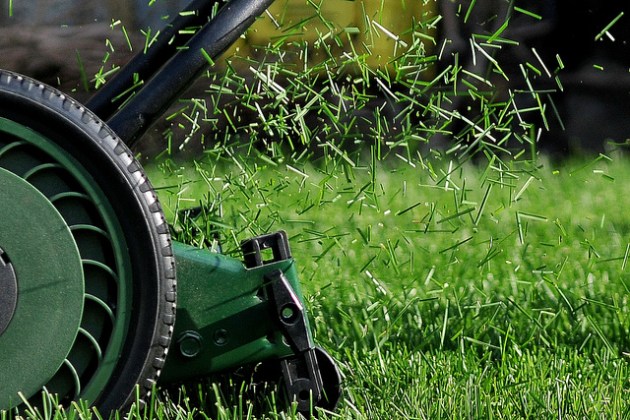
Cutting grass, at least to me, was always a cathartic experience, a means of purging the day to day evils of childhood.  It was never a chore.  An interruption, perhaps, of other things I’d have rather been doing, but never a chore.  Climbing up on that riding mower, the world took a back seat.  I felt like a farmer preparing to plow a field, and I’d ride off to the edge of the yard to begin tilling my rows.  I patterned my swaths just as I’d seen the big tractors do.  One or two rows across the ends of the yard, and then perpendicular rows up and down the length.

Cutting grass was not a task I took lightly or rushed to complete.  I practiced making the endless cuts as straight as possible across the longest part of the yard.  This was accomplished by fixing my eyes on a distant point of reference and walking or driving straight toward it without looking at anything in between.  Singular focus was essential and distraction a sign of fatal weakness.  A straight cut was the epitome of grass cutting perfection and I was relentless in this pursuit.  It is something that I unconsciously do even today.  I would hone my skills by deliberately cutting curves and arcs, and then straightening them again on the next pass.  Missing a clump here or a tuft there was unthinkable and inexcusable.

I learned that, whether riding or pushing, it was best to overshoot the end of the row prior to making my turn.  Curved corners were sloppy and left an uneven cut.  I also learned that cutting the grass in the same direction every week produced what I privately called a “grain” to the yard that was most unattractive.  Alternating directions each week produced better results, and changing the direction by 45 degrees on a weekly basis was preferable above all else.  I found that when the grass was too tall, I could get fine results without raking by cutting at twice the normal height, and then crosscutting the yard again at 90 degrees, this time at the normal height.  This resulted in a mulched effect long before anyone thought to market mulching as a feature.

In later years, and not too long before he died, my father purchased a “lawn tractor.”  It was a very large (by comparison) red Wheel Horse with an 18hp Kohler engine and a 52″ cut.  It was delivered on the back of a large flatbed truck with ramps that extended down the back.  I must have been 15 or 16 at the time and was in heaven.  I cut every damned thing in site for all of 2 or 3 weeks.  I even cleaned and cut the ditch on the (country) road between our house and my grandmother’s lane.  Beyond the other side of the yard I cut a nice slice of ditch 30 or so feet down the road that gradually curved away from the cornfield to the road itself.

Now I need to jump in here and make clear that our yard otherwise was not what you might call manicured.  I’d never seen a bag of fertilizer.  In fact, at the time, I was quite perplexed as to why anyone would encourage grass to grow in such a manner.  After all, I spent much of my time reducing it to a respectable height.  No, the weeds in our yard were healthy and robust and I don’t recall questioning their existence any more than I did the grass itself.  My sole artistry was in the cutting, not the growing.

On my 16th birthday, I came home from the DMV with my license, and with determination forthwith headed straight to my first job – cutting grass.  It was the “estate” (as I liked to call it) of Dr. and Mrs. Norman Rock Tingle.  Dr. Tingle was my doctor.  Hell, he was everyone’s doctor in the upper end of Lancaster County, Virginia.  I’m recollecting that it must have been about 10 or 15 acres – 10 to 15 acres of viridescent wonderland, fronting the Rappahannock River about 10 miles or so before it emptied into the Chesapeake Bay.  Bordering the property along the gravel road leading up to their drive was a long hedge of huge wiry bushes that far exceeded my height.  The paved driveway itself wound through towering pines and expanses of slightly rolling grassland that closely resembled a golf course.  From many areas of the property the house was not even visible.  Standing at the back porch overlooking the river, the yard sloped gently down to the water’s edge, transitioning from earth and fescue to sand and sea grass that bordered the shallow but respectable beach.  Extending out into the mile wide river was a dock (pier), whereupon in cooler weather I would have my lunch.

Situated across the parking area that faced the garage doors of the house was the shed that housed the yard tools and mowers.  I knew my employers well, if only in a doctor/patient way, but that combined with the innocence of youth precluded any feelings of nervous uncertainty at starting my first job.  Besides, the challenge that lay before me was quite clear and I was in my element.  The yard was, in my opinion, in a terrible state of mismanagement.  My predecessor, a school acquaintance one or two years my senior, obviously had neither the respect nor eye for lawn detail that I had.  The yard was suffering from “graining,” the result of constant mowing in one direction.  Worse, the grass around the trees and bushes was not properly trimmed, the edges and boundaries of the yard left haphazardly hacked at or conspicuously ignored altogether.  My counterpart “worked with me” for a couple of weeks to “show me the ropes.”  He gave me his version of what the expectations were and how much and how little I needed to do.  It was all completely irrelevant and I found his lazy discourse annoying and lack of pride offensive.  My mission was clear before I ever set foot on the property.

Within a month I had the yard much improved and was rewarded with sincere kudos and compliments that the place had “never looked so good…”  Though I didn’t say so at the time, I was a little puzzled by this recognition.  It never occurred to me that anyone (who cared) should not cut grass the same way.  I simply did it the only way I knew how, with attention to every detail, with respect for the magnificence of the property, and with passionate pride in perfection.  Partly for my effort, but mostly because the Tingles were nice people, I was rewarded with an open invitation to partake of the soft drinks kept in the bar refrigerator, just inside the lower level of the house.  This was a privilege I enjoyed with some constraint and considerable appreciation.

The cutting of grass facilitates a distinct perspective of the world.  The very nature of the task isolates the individual and deprives everything auditory; the abrasive drone of the engine allowing only the voice of thought.  Yet, while so isolated from the distractions of sound, the operator is paradoxically interconnected to the open expanse of all outdoors.  The permeating smell of cut grass and dust, the stifling heat of midday summer sunshine, the tactile vibrations of a mechanical beast rolling over undulating earth overwhelm the senses and lull the driver into trancelike euphoria, facilitating a spectacular playground for the hungry imagination.

The sheer size of the property necessitated long leisurely hours spent atop the big Cub Cadet, time that afforded the sweet luxury of colorful daydreams and inexhaustible adolescent introspection.  I concocted endless fantasy dates and detailed romantic relationships with the girls I knew.  Relationships ultimately destined to remain confined deep within the fragile chambers of my imagination, bound by the demons of insecurity and low self-esteem, and closely guarded by teenage male ego.

I had a particular romantic interest those days in a young lady who quite by chance, lived within bike riding distance of the doctor’s estate.  She knew that I worked there and I made a point of mentioning the days and times I’d be around in hopes that she might wander by, perhaps on her bicycle and perhaps wearing “Daisy Dukes” and a bikini top.  She gave all appearances of being superbly, magically and magnificently mammiferous, and of this I was enamored.

She was an odd sort of girl, a loner, very shy in a group and not at all popular.  She was not beautiful in the cheerleader sense, but pretty enough in my 16-year-old opinion.  She had amazing deep auburn hair, sparkling blue eyes, and the skin on her freckled face was the softest thing I’d ever felt.  There was something about her that I found irresistibly charming.  One on one, she was delightful – funny and chatty, yet always mysterious.  I still remember her laugh.  I liked that she was not popular.  Being with her felt… less competitive, more comfortable.  She was surprisingly easy to talk to, and with her I could just be myself without the high school machismo.  I probably could have fallen in love with her.  There was just something about her…

Of course she never came by while I was working, and despite my mostly honorable and completely sincere feelings of affection for her, we drifted apart after 6 or 8 months of periodic dates.  For whatever reason, Joan was not interested in me, would never even let me kiss her on the lips – only her cheek.  My heart could only take so much rejection.  There were other yards to cut, other bushes to trim.  I mowed on.

I guess I cut the grass on that estate for four, maybe five years before college got in the way, even during the summer break.  I didn’t know it at the time, but it would be some years before I would again cut grass.  Being young and distracted by new adventures of life on my own as a college student, I never looked back at the life I was leaving.  I suppose that is normal.  Still, I cannot remember the last time I cut the doctor’s yard.  There was a last time.  There would have to have been.  I just can’t remember it.  I had already moved on and I missed it, even as I put the mower away for the last time.

Last Sunday, I got my mower out of the garage.  A black Briggs and Stratton motor bolted to a nondescript gray chassis.  No bag attachment or self-propelled feature.  My 11 year old followed at my heels and asked when he would be allowed to cut our grass.  I cut around the outside boundary of the yard for him, and then showed him how to cut straight lines in neat rows up and down the length.  “Go past the end of the row prior to making your turn.  Curved corners are sloppy and leave an uneven cut…”

cutting-grass

***

The Complete Lee Enfield No. 1 MKIII Restoration

Lee-Enfield SMLE No. 1 MKIII

Lee-Enfield SMLE No. 1 MKIII

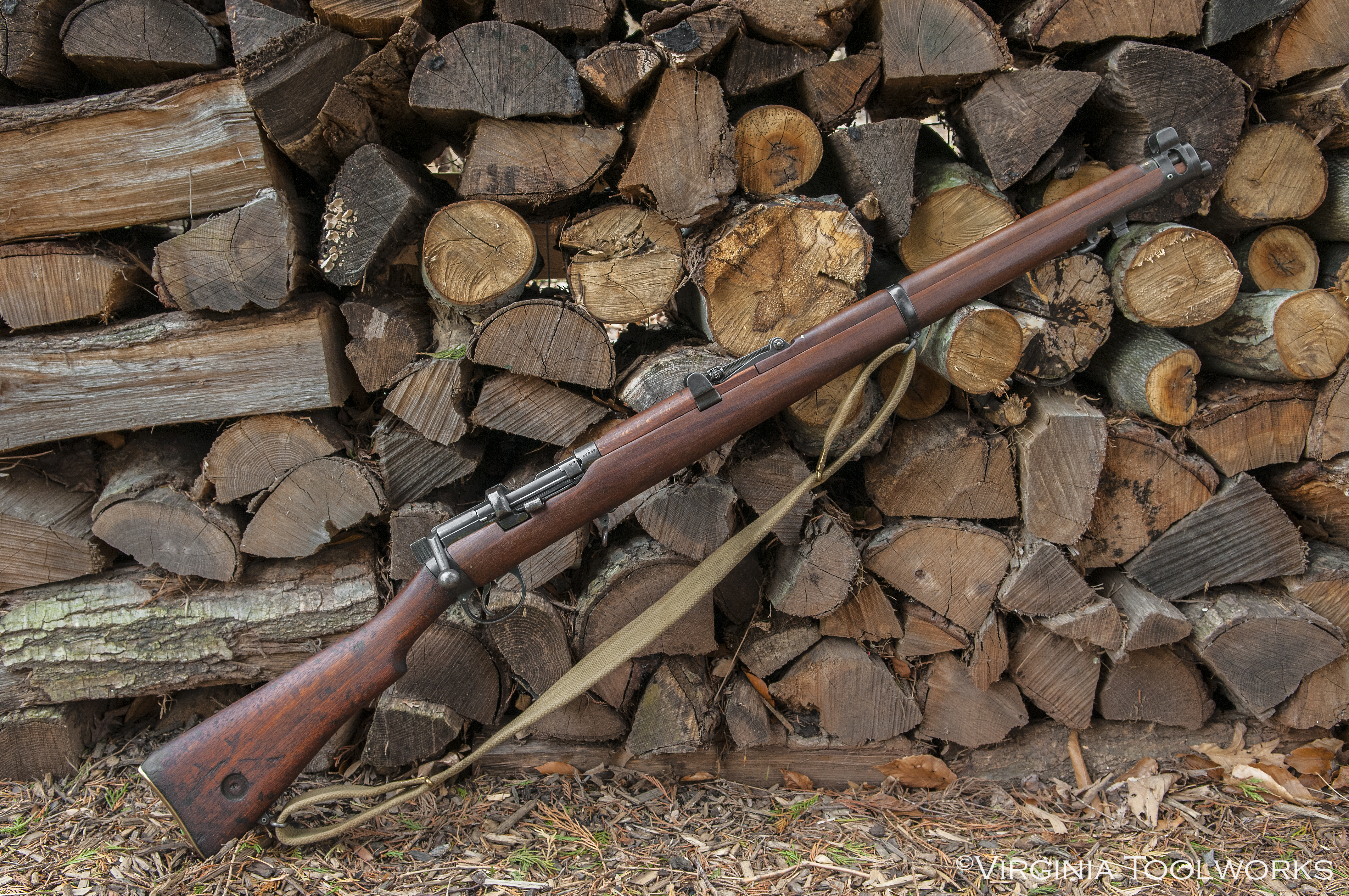
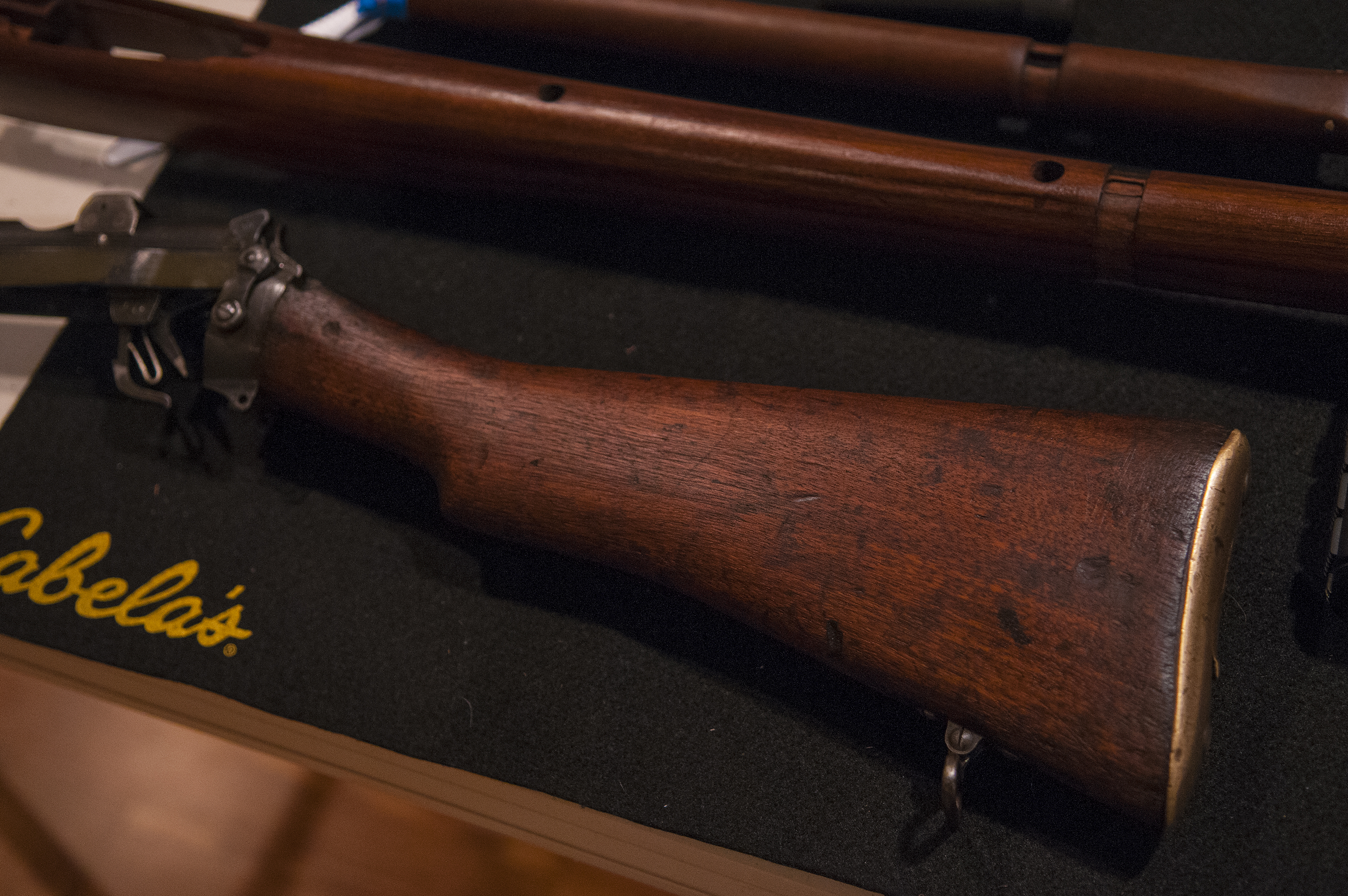
For those of you who have followed along, I finally finished up the Lee-Enfield this past weekend, and I’m pretty pleased with the results. To recap, this rifle was given to me by my father-in-law back in early January. It’s a Lee-Enfield SMLE (Short Magazine Lee-Enfield) model No. 1 MKIII (.303 British caliber) produced at the Birmingham Small Arms Co. in England in 1940. Lee-Enfields were manufactured from 1888 to the early 1970s, and total production was nearly 14 million rifles. This one appeals to me because it was made in England during the Battle of Britain, and shows evidence of actual deployment in combat.

The WWII No. 1 MKIII rifles are plentiful even today, and not particularly valuable. I probably exceeded the value of this one in the parts alone that I purchased, but I didn’t restore it to sell. It’s a keeper and a shooter that will be enjoyed and passed down.  As it happens, the first high-powered rifle I ever shot as a kid was an old WWI vintage Enfield that belonged to my uncle.  I remember that .303 kicked like a 12 gauge.  I may even still have that first casing somewhere in a box of my childhood stuff.

The Enfield before restoration with new forestock and hand guard above

The Enfield before restoration with new forestock and hand guard shown above

As I wrote in earlier posts, the rifle had been ‘sporterized’ at some point, or at least someone started that process. Unfortunately, this was a popular practice in the post war years. The guns were plentiful and cheap, and guys who bought them apparently preferred the look of a traditional hunting rifle. Since the Enfield featured a barrel fully shrouded in wood, sporterizing them usually began with removing the nosecap and hardware, the upper hand guard, and cutting off the front part of the forestock.  Sometimes the rear sights were removed or altered to accept a scope, but fortunately the bubba who hacked away at this rifle didn’t get that far.

The forestock had been cut and the upper hand guard removed

The forestock had been cut, the hand guard missing

The forearm on this rifle had been cut just behind the swivel band. The entire nosecap assembly at the front was missing, along with the swivel band, forward swivels and a variety of related hardware, and the upper hand guard. The rear hand guard was still there, but its ears had been cut off and so it needed to be replaced. It appeared all of the remaining wood on the rifle was scrubbed with a heavy wire brush, leaving the surface pretty rough and scarred with brush marks. All of the original finish was long gone.

After the initial disassembly and inspection, I was happy to find the action and barrel in surprisingly good condition. Areas of rust were minimal and superficial. All the serial numbers thankfully matched, so I knew everything was likely original. The action and barrel had significant areas of olive drab paint, which I discovered was routinely applied to rifles used in tropical climates during WWII to help prevent rust. I was careful to leave that intact.

Enfield Serial

Receiver with bolt removed – original forestock still on the rifle (note the olive drab paint)

I was able to identify and source all the missing parts without too much trouble. Since there was such a long bedding space on the Enfield’s full length forestock, I decided to go with an unissued but old forestock and hand guard assembly. With so much hand fitting required, I didn’t want to take a chance on a stock that had already been on another rifle. I may have been misguided in this assumption, but that’s what I did. I left the original buttstock on the rifle since there was no need to replace it other than the aesthetic contrast between it and the new wood. I preferred to keep the rifle as close to original as possible.

Enfield New Stock Fit 1

Fitting the new forestock to the receiver – completed

The new wood required quite a bit of fine tuning and adjustment to get it to fit the receiver and barrel correctly. There are several fairly critical areas on Enfield rifles where the wood needs to fit very flush against the metal, so the work was slow and cautious. With so many parts all needing to come together and a half-dozen attachment points that all had to be aligned, I spent more than a few hours wondering why I ever started this project. But in the end, it all finally came together and I feel really good about the fit. It seems to fit like a glove where it’s supposed to, with the appropriate generosity in the other areas where called for.

The hand guard sat too high for the nosecap to slide on

The hand guard sat too high for the nosecap to slide on

Of everything on the rifle, the nosecap I sourced ended up being the most difficult part to get properly installed. Initially the upper hand guard sat too high for the nosecap to slip over it properly. That required carefully reducing the height of the guard along its full length, but not so much that the top of the barrel would bottom out preventing it from seating against the forearm. Once that problem was resolved, I then found that the screw holes through the forearm were just lightly out of alignment, preventing the front nosecap screw from engaging the threads on the opposite side of the nosecap. Eventually, with a lot of patience and careful filing, everything fell into place and the wood was ready for the finish.

While not the most practical by today’s standards, I wanted to keep this rifle as true to original form as possible, and so went with the tried and true linseed oil finish. This is what was used when the rifle was made. Since boiled linseed oil is chemically different, I used raw linseed oil. Or at least I assume it’s raw. I had a can of artist’s grade linseed oil that I bought when I was in college 30 some years ago and never opened. I cut it with 50% turpentine to help ensure it would dry sometime this decade. Following the old adage, once a day for a week, once a week for a month, I’ve applied about 8 ‘coats’ and the results look great. The wood has a nice rich low luster and even the contrast between the new wood and the old stock doesn’t jump out too much.

Enfield Complete 4

Rear Sight with new upper guard in place


I completed the restoration with an original WWII vintage Enfield sling, also dated 1940, that I found on eBay. That and the war vintage bayonet I previously wrote about are the icing on the cake. Not that I need a bayonet, but it’s in unissued condition and the price was too good to pass up. I’m looking forward to putting a couple dozen rounds down range sometime in the next few weeks.

Lee-Enfield SMLE No. 1 MKIII

Lee-Enfield SMLE No. 1 MKIII

***

Some things are too important to part with…

W P Bryant's Straight Razor
I found this straight razor in some old family stuff. It’s German made and pretty nice quality, even if in rough shape. I cleaned it up a little and photographed it to sell. However, when I processed the photo in Photoshop, I saw in the enlarged image a name faintly inscribed in the tortoise shell handle. So I got out my trusty magnifier and found the name “W P Bryant” very nicely (and lightly) inscribed in a fine script.

I immediately realized that this razor belonged to my great uncle.  W P stands for Walter Paine, and Bryant is the family surname for which I am named. Now Walter was a sad story. He was my grandmother’s brother and a dreamer and want to be entrepreneur.  Unfortunately, he killed himself in 1908 when he was about 26 years old (as I recall). If anyone in the family every knew why he did it, it was never discussed.  He spent an evening with friends, went home and shot himself.

So, I won’t be selling the razor. I’ll just add it to a shelf with all the other stuff I can’t bring myself to part with.
***


Restoring a WWII Vintage Lee-Enfield Rifle – Part 3 (Bayonet)

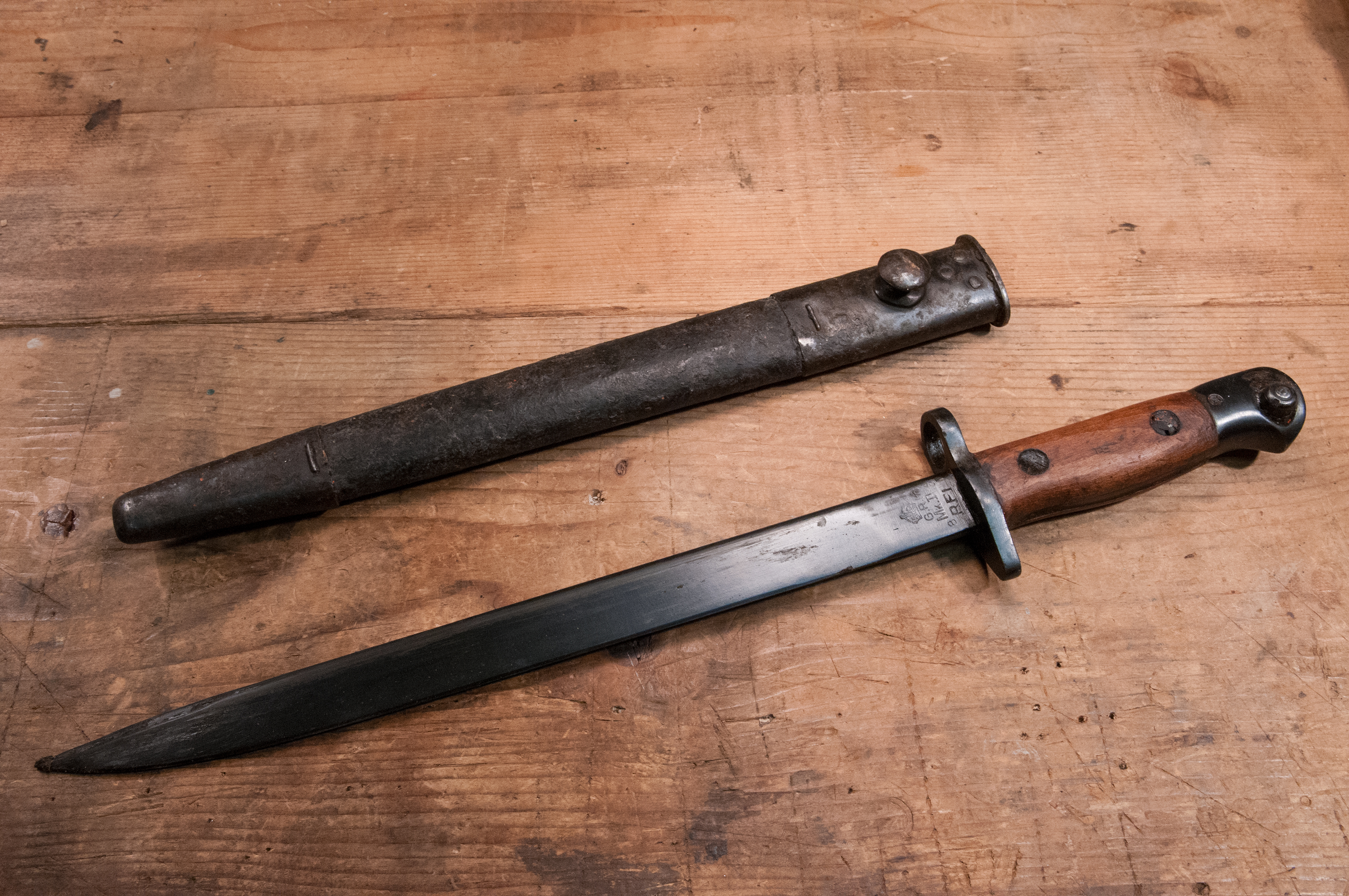
I bought this WWII vintage Enfield Bayonet to go with the rifle, because… well… who doesn’t want a bayonet?  This one is date stamped 1943, so it was made three years after the rifle, but it’s period correct and close enough.  Besides, it was never used and still caked in 70 year old cosmoline.  As you can see below, while the bayonet was in pristine condition, the scabbard looked pretty rough.

Enfield Bayonet, c. 1943

Enfield Bayonet, c. 1943 ~ Before cleaning

As I’m prone to do, I researched how best to clean leather scabbards, and of course came up with a whole lot of opinions that varied considerably.  In the end, I decided to use saddle soap.  The scabbard is 70 years old and will never again see a hard life, so I don’t think saddle soap is going to do it much harm.

Starting with the bayonet itself, I used mineral spirits with a cotton rag and toothbrush to clean the cosmoline off the metal surfaces.  Using a non-abrasive brush ensured I didn’t scratch the bluing, which is absolutely perfect.  The cosmoline melted right away and I was quickly rewarded with a stunning mint condition WWII vintage bayonet.  If the wooden scales ever had any finish on them, it was long gone, so after everything was dry and wiped clean, I rubbed them down with some of the linseed oil finish I’ve been using on the stock.  The rest of the metal surfaces got a wipe with Kramer’s Best, which is a linseed oil, turpentine, and vinegar based solution that is an outstanding wood and metal conditioner.

After cleaning and conditioning

After cleaning and conditioning

The scabbard required some additional care since most of it is comprised of hard leather.  I cleaned the metal surfaces first, removing the cosmoline and leaving the natural patina of the metal.  Then I went to work on the leather surface itself using the saddle soap.  It was a very slow process with little apparent progress at first.  After a half dozen or so cycles of applying it, wiping it off, buffing it out, I felt like I had reached a point of diminishing returns.  At this point the leather was sufficiently clean, but very dull in appearance.  So I went out on a limb and rubbed it down with shoe crème (not shoe polish).  The shoe crème has always been recommended to me by the place that sells Allen Edmonds.  It’s basically a leather conditioner with some black dye.  It has no wax so it lends itself well to subsequent treatment.  I also doesn’t shine like wax, which is perfect in this case.

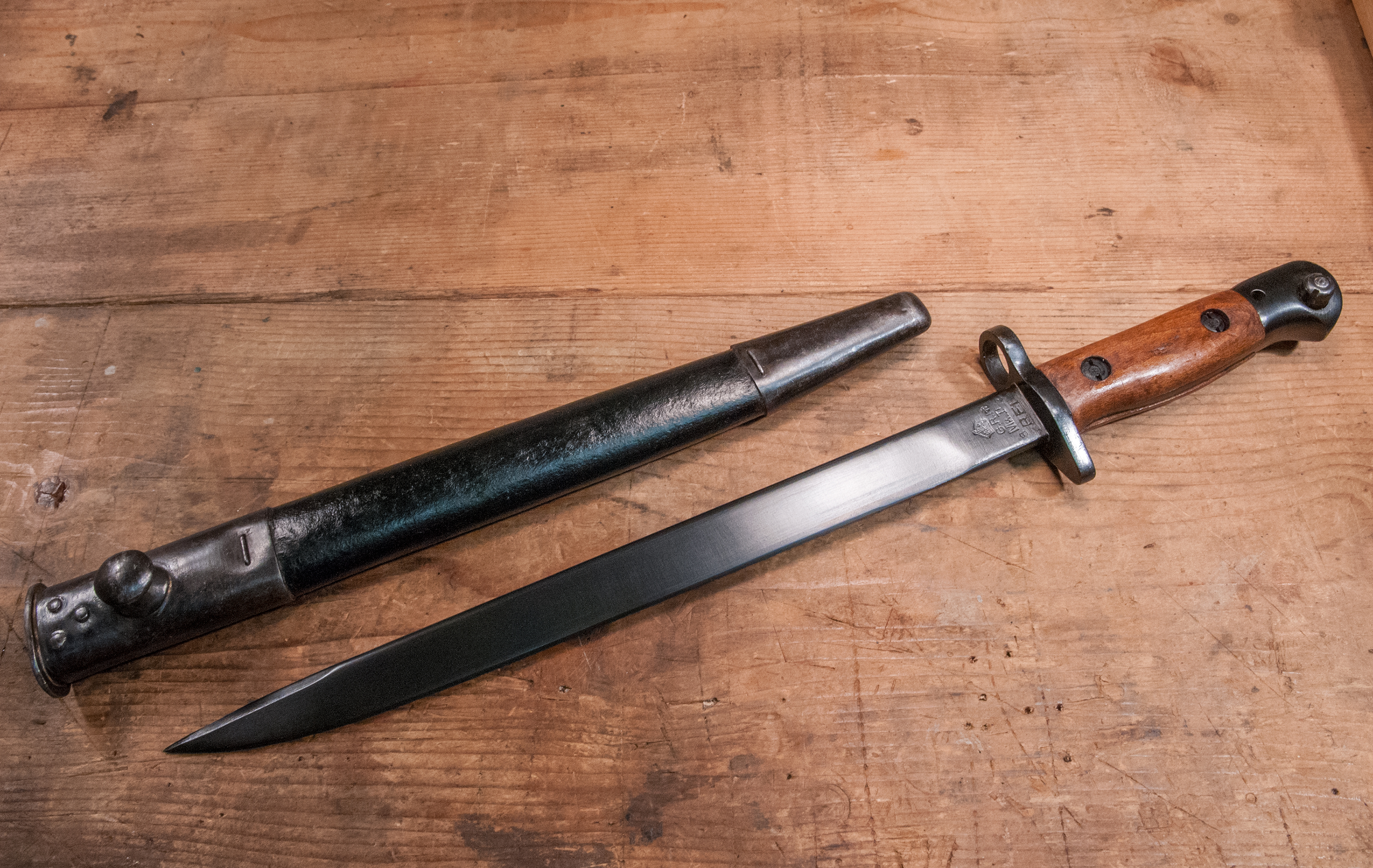
The result, which you can see in the image above as well as below, is pretty remarkable.  It’s hard to see in the photos, but the leather looks like it’s brand new.  Yours truly is a happy camper, and I’m looking forward to seeing my boys’ reaction to the transformation.

I’m cycling through the daily application of oil on the rest of the rifle’s furniture, and in fact think today is probably the last one.  I may just go ahead and reassemble the whole thing tomorrow and make sure everything fits properly.  I only wish I’d done a better job of labeling all those parts on my work table.

Bayonet and Scabbard completed

Bayonet and Scabbard completed

***

Restoring a WWII Vintage Lee-Enfield Rifle – Part 2

It’s been a couple of months since I first wrote about restoring the old 1940 vintage Lee Enfield no. 1 MKIII rifle.  (See the earlier post)  I managed to source all of the missing parts, including a new forearm and hand guard set.  I found an unused set of unknown date, but I figured I’d be better off fitting a new stock than buying an old one and hoping it would fit properly.  Enfields, especially the no. 1, are notoriously finicky when it comes to proper stock fit.

Relacement Wood

The Enfield with original furniture in place, just before disassembly

In the photo above, you can see the rifle in its original, butchered forearm.  The lower forearm was cut off and the hand guard discarded, along with the entire nose cap assembly.  The new replacement stock, forearm, and hardware are shown above the rifle.  The new wood appears darker in the photo, but once I work on the buttstock a little and the oil finish is applied, I think it will look okay.

After removing the entire lower forearm, I found that the action in excellent condition.  There was a couple of traces of light rust, but nothing of any consequence and no corrosion damage.  I tried to remove the buttstock, but the screw that attaches it is deep inside the stock itself, and requires a very long screwdriver. Unfortunately, the screw is locked up pretty tight, and rather than risk buggering up the slot, I decided to just leave it on and refinish the stock in place.

The first order of business was fitting the new stock. It wouldn’t seat at all on the first try and required some fine tuning to get it to slide over the receiver.  Going slow, I had it properly adjusted and fitting like a glove in short order.  Moving on to the upper hand guard, I had to take a little off the inside of the ears to get it to slide easily into place around the rear sight.  This is not supposed to be a tight fit, and I may have to take a little more off after it’s finished.

Enfield New Stock Fit

The new stock slides right into place after fitting

With everything looking good, I put both forearm and hand guard in place and slipped on the nose cap for a dry fit assessment.  As you can see in the photo below, the upper hand guard sits too high for the nose cap to slide on properly. Using some folded paper, I was able to determine that I had about 0.5mm of surplus height within the hand guard to work with.  By sanding the bottom edge of the hand guard on my trusty flat granite sharpening surface, I reduced the height enough to let that nose cap slide into place.   Everything looks good at this point, so onto cleaning the action and applying the finish.

The hand guard sits too high for the nose cap to slide on all the way

The hand guard sits too high for the nose cap to slide on all the way

All of the wood on this rifle was stripped at some point in its past and scrubbed with a heavy wire brush, leaving a lot of marks in the wood.  I lightly sanded the worst of these marks, but didn’t want to lose all the character of the wood, so I really did just enough to open the grain a little for the new finish.  At this point, I went ahead and cleaned the action and barrel thoroughly.  There was some crud, but not as much as one might expect from a gun this old.  Thankfully, I think the gun was cleaned after it was last shot, so it didn’t take a whole lot of effort to get it looking good.

Action cleaned up.  I'll lightly clean and oil it again before final assembly to remove any dust or grit that accumulated during finishing

Action cleaned up. I’ll lightly clean and oil it again before final assembly to remove any grit that accumulated during finishing

I decided a while back to use the original type of oil finish that was applied when this gun was made (or as close as I could reasonable come).  In WWII and earlier, most military gun stocks were finished with linseed oil, or something close to that.  Although not very effective against the elements, it is very easy to maintain. Rather than use Boiled Linseed Oil common today, which is modified with petroleum distillates to speed drying, I’m using artist grade linseed oil, which I assume is basically raw oil.  I happened to have an unopened can that is about 35 years old and it doesn’t specify.

Starting with a 50/50 ratio of oil to turpentine (to help it dry), I began applying coats with 4-0 steel wool.  I really hate steel wool.  It just makes a mess with steel wool fibers everywhere.  I abandoned the wool after the first application and just rubbed it on by hand after that.  Using the old adage, once a day for a week, once a week for a month, and once a month for a year, I’m on day three and the wood looks fantastic.  I don’t think I’m going to go for the full seven applications.  This morning I upped the ratio of oil to turpentine to about 70/30.  If it doesn’t dry within 24 hours or so, I might add a little japan dryer to the next batch.

The stock and hand guard with 3 coats of oil applied

The stock and hand guard with 3 coats of oil applied

The next update will cover cleaning up the 1940s vintage bayonet I found for this gun!

***

New Address: www.virginiatoolworks.com

Virginia Toolworks can now be accessed directly through the domain name virginiatoolworks.com!

It’s a humble achievement, I know, but it reflects the growth and increasing popularity of this site.  Thanks to all who visit, and a very special thanks to those who follow this blog and the Virginia Toolworks Facebook page.

Thank You!

Stanley Bailey no. 60, Type 2, c. 1901-04

Stanley Bailey no. 60, Type 2, c. 1901-04

***

Goldsmith, Silversmith, & Jewelry Tools, Old and New

Years ago after graduating from college, I wanted to pursue a career that would allow me to do something creative, something hands-on. There were a lot of directions I could have taken, but I had a unique opportunity through a family connection to apprentice with a 3rd generation Greek goldsmith who had recently immigrated to the United States.  It was a small family business, and they specialized in designing and fabricating custom jewelry entirely by hand.  I knew nothing about jewelry or metal work, but after my first day I was completely hooked.

My apprenticeship lasted 2 years and 3 months before I moved on to a new opportunity.  That’s not a lot of time considering it easily takes 8 to 10 years or longer to become truly proficient as a bench jeweler.  As it turned out, my career path led me away from jewelry bench-work as a daily profession.  However, I never completely gave it up, and some years later was able to outfit a small shop with the tools and equipment needed to make enough jewelry to keep the female members of my family content.

Jewelers Bench ToolsThe vast majority of the vintage tool market focuses on tools for woodworking.  Yet while many modern woodworkers use power tools more or less exclusively, silversmiths and goldsmiths still use hand tools for most of their work.  While electricity has added considerable convenience, many of the hand tools used by gold and silversmiths today haven’t changed substantially in a couple hundred years or longer.  For tool junkies like you and me, that opens up a whole wealth of fascinating and elegant tools for us to appreciate.

The Work Bench

Jeweler's BenchNot at all unlike a woodworkers bench, a goldsmith’s, silversmith’s, or engraver’s bench is the centerpiece of his work space. It is my understanding (through my training) that the craftsman traditionally constructed his own bench.  I honestly don’t know if this is true or not, but given the typical complexity of such benches and the fact that they are so uniquely and uncommonly personal to the  individual, it would not at all surprise me.  Commercially made benches are available today through jewelry tool distributors like Gesswein and Rio Grande, but they tend to be too lightweight and of mediocre construction for anything more than occasional use.

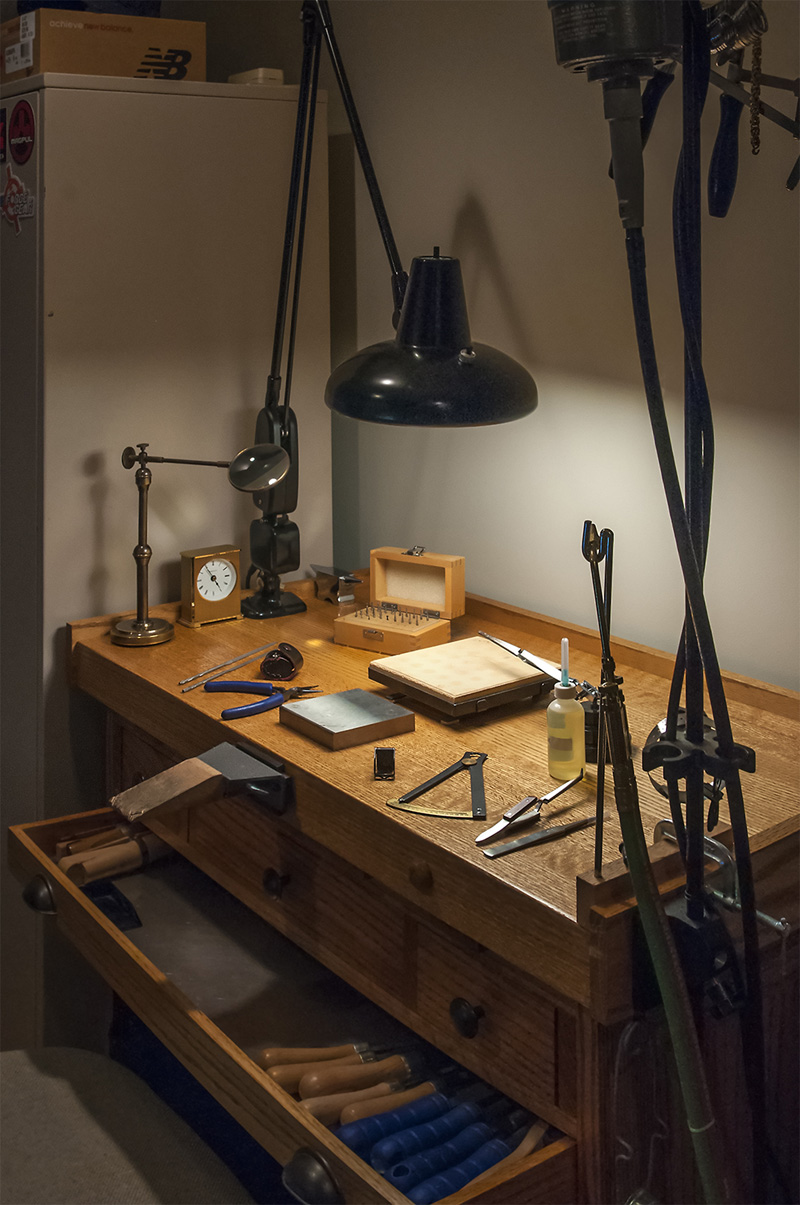
My BenchI built my bench about 10 years ago (shown at the right).  I designed it specifically for my height and work style, with a 3-1/2″ thick butcher block top of solid oak.  Weight is important in these benches – heavier is better.  You can see in the photo there are three tool/supply drawers, and below them two very wide and shallow drawers.  These are lap drawers that catch the metal filings as they fall, extremely important when working with precious metals.  The filings and scraps are all collected and sent to a refinery for reclamation.  Even old sandpaper is saved.  I built my bench with two lap drawers for convenience and practicality, as I often work on more than one project at a time and sometimes work with both precious and non-precious metals.  It’s better to keep the two separated.  Naturally, if I had it to do over I would do several things differently.  The drawer face on the far left doesn’t match the other two very well, and it bugs me.  I also made some stupid mistakes with some of the framework, but all aesthetic.  I was so consumed with the functional aspects that I didn’t give enough thought to how it would all look.

Common Bench Tools

Silversmith HammersIn terms of breadth and depth of assortment, woodworkers would be hard pressed to compete with the average goldsmith or silversmith for quantity of tools.  In addition to files of various shapes and sizes, there are any number of pliers, hammers, saw blades, hundreds of rotary tool bits, polishing wheels, bench blocks, mandrels, staking tools, torches, tweezers, magnifiers… the list goes on and on.  Further, like blacksmiths, goldsmiths and silversmiths must make many of the tools they use.

Metal colour samples-2Fundamental to virtually every bench is a wooden bench pin, steel bench block, jeweler’s saws, pliers, hammers and files.  The bench pin is a wedge-shaped block that protrudes from the front of the bench and serves as a support for filing and sawing, as well as a leverage point for everything else.  Steel bench blocks sit on top of the bench, are dead flat, and serve as all-purpose platforms for flattening and shaping softer precious metals.  Jeweler’s saws come in a variety of depths.  The interchangeable saw blades are positioned with the teeth pointing toward the handle, so they cut on the down (or pull) stroke.

Because they are used for precise work, jeweler’s tools tend to be precision tools.  Measurements are typically in tenths or thousandths of a millimeter, and when working with metals that cost almost $2,000 and ounce, material efficiency and waste reduction is an obsession.  Every precious metal dust particle is quite literally considered and every effort is made to recover as much as possible.

Heavier Shop Equipment

Rolling MillSmiths also use a variety of heavy shop equipment depending on the manufacturing techniques they employ.  Rolling mills like the one shown here roll out sheet stock and wire to be used in fabrication.  It is a slow and laborious process.  Some jewelers use casting equipment to cast wax models into gold, silver, or platinum.  The wax model is encased in plaster with an attached sprue.  The wax is melted out leaving a cavity in which the liquid metal is injected through either a vacuum or centrifugal force. Production shops use CAD computers, computerized crucibles and casting machines, and laser soldering devices costing tens of thousands of dollars.

Alongside every goldsmith bench is a small torch.  Since my bench is in my home, large propane and oxygen tanks were not an option, so I constructed a portable tote for the small disposable tanks available at hardware stores.  This works fine for soldering jewelry, but for melting metal or larger jobs, a standard size setup is necessary.

Every metal worker needs a polishing machine, and mine is typical of those found in smaller shops.  It is a floor standing model with hoods and a powerful dust collection unit.  This not only keeps the work space cleaner, but captures most of the particulates, which are comprised of a surprisingly high percentage of fine metal material.  This too is sent for refining and metal reclamation.

Stone Setter’s and Engraver’s Tools

An engraver’s bench is virtually identical to a jeweler’s bench.  However, an engraver will have a special ball vise that rotates 360º as he works.  His tools, called gravers, have profiles of different shapes and thicknesses, much like wood carving or turning tools.  Before he begins cutting metal, the engraver typically applies china white, a chalk-like substance that let’s him draw on the metal.  The intended design or inscription is very carefully hand drawn, and the engraver then follows the lines with the gravers, removing thin metal curls.  Some gravers are used for letters, others for outlines, and others still for removing or defining the background.  Like goldsmiths and silversmiths, engravers spend many years, even decades, mastering their craft.  It is a beautiful and dying art.

EngravingToolsYou might be surprised to learn that many of the tools used by engravers are also used by stone setters.  As mentioned above, gravers are used to remove metal.  In certain setting styles they can also be used to create beads that form prongs for gemstones.  Pavé settings start with a drilled hole that is then tapered with a small bur shaped much like a counter-sink bit.  “Prongs” are then engraved up from the surrounding metal to form a tiny bead that covers the edge of the stone.  Now, if you think that sounds complicated, consider this… because Pavé settings feature many stones in extremely close proximity, each bead is formed to cover the bezel of not one or two, but three adjacent gemstones.  This type of setting is extremely precise and requires extraordinary skill.

Watchmaker’s Tools

Watchmakers are an entirely different breed; the level of precision required of a true watch maker is unparalleled.  The market today is dominated by disposable quartz movements, so old-fashioned watchmaking is a dwindling profession. There are only a handful of companies at the very highest end that even still make mechanical movements.  Sadly, fewer and fewer young people are willing to invest the time it takes to become proficient to work on mechanical watches.  While the earning potential for the highest skill levels is significant, entry-level workers are not highly compensated.

Watchmakers employ a dizzying array of tools, parts, and devices.  The traditional centerpiece to the watchmaker’s bench is the lathe (shown in the photo above).  Employing many of the same skills and techniques of the goldsmith, watchmakers demonstrate proficiency in the fine jewelry arts as well as the mechanical skills required to build and repair watches.  It’s not surprising that so many individual jewelry proprietors of the last century were generalists in this regard, working on both jewelry and watches as a service to customers.

wathcmakers benchWatchmaker’s benches typically differ from jeweler’s benches in both function and design.  Generally forgoing the lap drawer, watchmaker’s benches are easily identified by the plentiful small drawers and cabinets for storing parts and tools. Earlier benches often had a foot treadle for powering the watchmaker’s lathe built right in. These were often magnificent pieces of furniture, with a charm and character unique to the profession.  It was also common for them to have lockable enclosures such as hinged lids or roll tops to prevent opportunistic theft of valuable tools and materials.

Summary

This is by no means a comprehensive or complete review of all the tools used by these craftsmen.  In fact, I’ve barely scratched the surface.  Clearly, woodworking tools hold a broader appeal, probably because the average person can better relate to their use.  Tools of the jeweler, goldsmith, silversmith, engraver, and watchmaker tend to be viewed as a bit more exotic and intended for very specific, and often unfamiliar, uses to most people.  I suppose that’s true, but only to a limited extent.  I use many tools in woodworking that were designed for the jewelry bench, simply because they suit a particular need better than anything else available. Nevertheless, exotic or not, it’s easy to appreciate their form and function and place in the realm of fine hand craftsmanship.

28452362

***