Something Different – Restoring a WWII Vintage Lee-Enfield Rifle

I’m starting a new restoration project this week, and a first for Virginia Toolworks – a firearm. This Lee-Enfield No. 1 MK III rifle chambered in .303 British was made in England in 1940, right smack in the middle of the Battle of Britain!  It quite literally was a rifle that helped save Great Britain from the Nazi onslaught, and then saw service throughout the war.  Pretty cool!

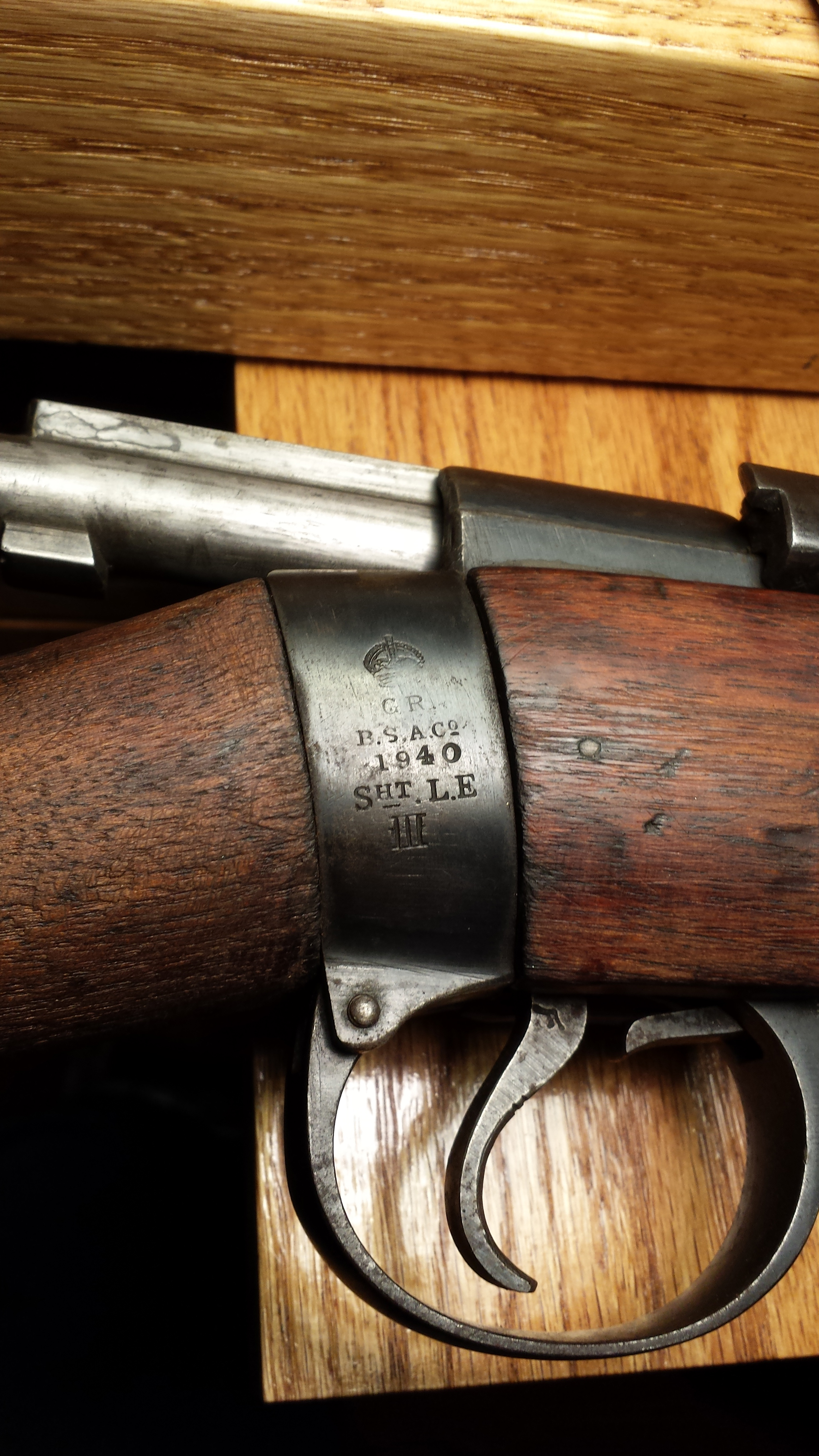
Enfield Receiver

Lee-Enfield No. 1 MK III (c. 1940)

Enfield Model MarkThe Lee-Enfield bolt-action, magazine-fed, repeating rifle was the British Army’s standard rifle from its official adoption in 1895 until 1957.  This one is in excellent condition overall, complete with matching serial numbers. If you look closely at the photos, you can see the barrel was painted olive drab. This was a common practice with WWII era Enfields that were used in humid climates such as Africa and the Pacific.

The only apology is the unfortunate attempt on someone’s part to “sporterize” it by removing the upper hand guard and cutting off the lower forearm. This was a common, albeit ill-conceived practice after decommissioning to make Enfields look more like hunting rifles.  Tens of thousands, if not more, of these rifles were converted in this manner, a practice that is not unheard of even today.  In fact, there are companies now making modern style synthetic stocks for these old rifles.  Enfields are among the most beautiful military rifles of the 20th century, and given its lineage and condition, this one deserves to be properly restored.

Enfield Armory Marks

The “40” stamp indicates the barrel is original

Enfield rifles have a somewhat distinct look in that the barrel is shrouded in wood from the receiver to the end of the barrel.  Since the wood on this one has been sawed off, I will need to replace the damaged and missing pieces and source another nose cap, which is also long gone. Since millions of these guns were made, wood of the correct model shouldn’t be too hard to find.  The nose cap is the most unfortunate missing part because they were stamped with the gun’s serial number, so it will always be that one mismatched part.

I am by no means a gunsmith, but I do know my way around weapons at little. Fortunately, there is very little rust, no visible rust damage that I can find, and the action and bore appears to only need a good cleaning.  The one part in the photo above that shows rust is a retention clip for the rear hand guard.  This is an easy fix.  I’m looking forward to putting this rifle back into its original condition, or at least as close as it can get.  Now, if I can just find some ammunition for it…

Enfield Cutoff

Bubba’d cutoff (ugh!) – Olive drab paint was applied in tropical climates to inhibit rust. It will stay!
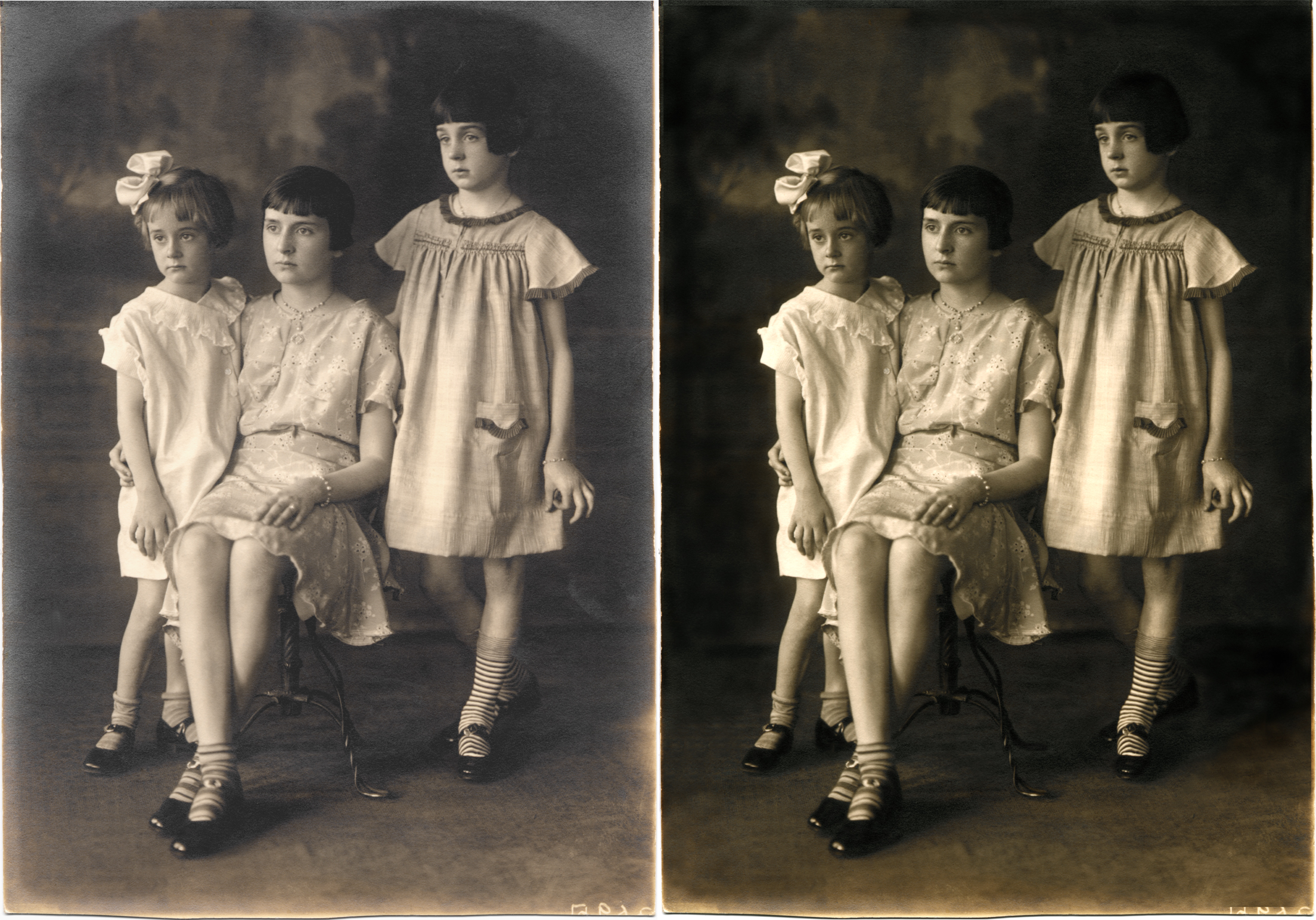
Preservation Beyond Tools – Digital Restoration of Photographs

Tools are not always the only thing restored at Virginia Toolworks. This is a family photo of my mother and her sisters (c. ~1932) that I restored for her 10 years ago. The original photo shown on the left was scanned at a high resolution.  You can see evidence of the silver oxidation and fading, especially around the edges.  Restoration was accomplished through digital manipulation using Adobe Photoshop . The restored image, shown on the right, was then printed on special 100% cotton paper using archival inks.

Pre-Post Comp - Family Photo

Merry Christmas from Virginia Toolworks


And she brought forth her firstborn son, and wrapped him in swaddling clothes, and laid him in a manger; because there was no room for them in the inn.

And there were in the same country shepherds abiding in the field, keeping watch over their flock by night.

And, lo, the angel of the Lord came upon them, and the glory of the Lord shone round about them: and they were sore afraid.

And the angel said unto them, Fear not: for, behold, I bring you good tidings of great joy, which shall be to all people.

For unto you is born this day in the city of David a Saviour, which is Christ the Lord.

And this shall be a sign unto you; Ye shall find the babe wrapped in swaddling clothes, lying in a manger.

And suddenly there was with the angel a multitude of the heavenly host praising God, and saying,

Glory to God in the highest, and on earth peace, good will toward men.

Luke 2:7-14

Happy Thanksgiving from Virginia Toolworks!

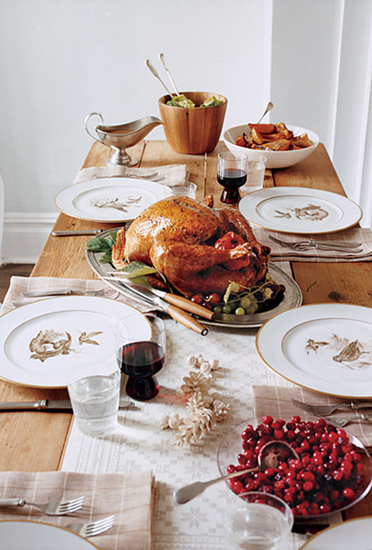
Thanksgiving Farm TableWishing everyone a very peaceful and reflective Thanksgiving!  Whether alone, with family or friends, at home or traveling, Thanksgiving is a day to rejoice and be grateful for what we have.  We are truly blessed as a nation, and as a free people.  Please remember those who protect that freedom, especially those who serve in our military, both home and abroad.  Remember and be thankful for their sacrifice and the sacrifice of their families who gather tomorrow with an empty place at the table.  Not everyone gets to go home for Thanksgiving.

The black Friday sales can wait.  Just give thanks – simple, selfless thanks.  “Give thanks to the Lord, for He is good. His love endures forever.” Psalms 106:1

Happy Thanksgiving!

Virginia Toolworks Facebook Page!

Virginia Toolworks CoverVirginia Toolworks now has a Facebook page!  Come check it out for more information about woodworking and working with hand tools.  You’ll also find an occasional dash of conservative values, guns, whiskey, hunting, fishing, and anything else that strikes my fancy.

Feel free to contribute, comment, and interact!

Virginia Toolworks Facebook Page

Greatest Table Saw Quote Ever

I was doing some research today and ran across the following quote on sawmillcreek.org by a guy named Jonathan McCullough.  Dating back to 2010, it is quite simply the grandest description I’ve ever read of the table saw beast, and I thought it too good not to share.  So Jonathan, whoever you are and wherever you are, here’s to you!

“I wish someone would pop up at my door with a pickup truck saying how much they wanted a table saw.  No doubt. Mine is powerful, well tuned, has all sorts of doodads, and I hate it. Hate It. It’s dangerous and spews out a choking cloud of microfine particles. It dominates the garage like a cast iron miasma of self reproach, with tendrils reaching out and stinking up the place with all sorts of jigs and crap that take up even more room.”

 ***

New Old Vintage Planes for Sale

I will be listing several planes and other tools for sale over the next few months.  You can view current offerings by clicking on For Sale on the menu bar.  To view these tools in greater detail or if you are interested in purchasing, please visit the Virginia Toolworks eBay page at http://www.ebay.com/sch/virginiatoolworks/m.html.

***

Save Those Apple Wood Scraps!

Back in the summer I came across some live edge apple wood slabs that I thought might be perfect for making small appetizer serving boards for gifts.  Now I know what you’re going to say – apple is notorious for warping and cracking.  True enough, but given the size and casual nature of this particular project I wasn’t overly concerned.  The working properties of apple, however, is not the subject of this post.

Since these were rough sawn pieces with bark still attached in places, I used what I could, but ended up with a lot of unserviceable scraps left over.  Rather than toss them out, I kept them for use in my smoker.

I’ve long been a fan of using hickory or pecan for smoking pork.  On the few occasions when I’ve smoked beef, I’ve used a little oak or mesquite, although the latter is not my favorite.  Apple chunks are not always the easiest thing to find, and while I’ve heard others extol its virtues for creating irresistible pig pickin’s,  I could not personally attest to the fact.  So when I recently decided to smoke pork ribs for a group of my co-workers, I used apple wood for the first time.

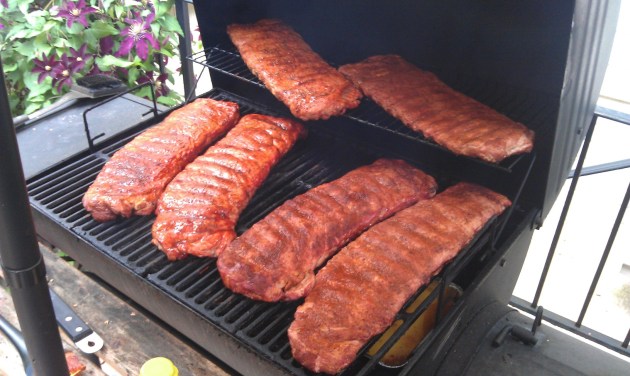
Smoking Ribs

I’m a bit of a purist when it comes to both ribs and pulled pork barbecue.  I use a dry rub (of my own making, of course) and if I’m feeling very generous, might allow a sauce on the side when the meat is served.  I apply the rub at least a few hours before cooking, and then smoke the ribs for 2 hours at 200-225 degrees.  After 2 hours, I baste the racks generously with a mop sauce (sorry, the recipe is my secret), seal them up tight in aluminum foil, and let them bake right on the smoker (so smoke, just heat) for another 2 to 3 hours.

So instead of my standby hickory, this time I used the apple wood scraps left over from the serving boards.  All I can say is “Oh my goodness, I had no idea what I’ve been missing!”  The flavor was much more subtle than that imparted by hickory, and considerably more appealing.  Rather than flavoring the meat so intensely, the apple smoke delicately complimented the dry rub seasoning, resulting in ribs that were perfectly smoky, tangy, and just plain bone sucking, slap your leg and pass the sweet tea good.

My co-workers went nuts over them, claiming them the best ribs they’d ever eaten.  I have to admit, they were easily the best ribs I’ve ever produced on my smoker and among the tastiest I’ve ever sampled anywhere.  Apple wood for smoking pig parts is now my permanent go to.  So save those apple wood scraps, or better yet, ship them to me.  Otherwise, I may need to find my own apple orchard.

***

Whiskey, Guns, & Everything Else…

Here at Virginia Toolworks, woodworking and vintage hand tools are clearly the priority. But the fact is, my passions are varied and eclectic, and I tend to go off on tangents every now and then.  To that end, wood is not the only material I like to work.

For those of you who follow this blog, you’ve probably noticed that I’ve been a little quiet lately.   Silence, however, does not equate to inactivity.  As soon as the summer temperatures moderated back in early September, I dove back into a built-in desk project that I started in the spring.  For a variety of reasons, my woodworking projects are typically executed during the spring and fall, so I plan accordingly.  The winter months are primarily dedicated to tool related projects, restoration and sales.  I use the summer months for research, writing, and other pursuits (hence the title of this post).

The built-in desk is part of an ongoing renovation of my home office.  Completed in late September, I then needed to address another problem that has been looming since November of 2010.  It was at the end of that month, almost two years ago, that my main computer blew a silicon gasket and suffered an unrecoverable death.

Now, in addition to my obsession with woodworking and vintage tools, I’m a computer geek.  Yes, I see the irony of this.  Despite this seemingly unabashed dichotomy, the two worlds do co-exist peacefully.  But I digress.

So, for the last two years I’ve worked off of the “family” computer – the one shared by the wife and kids.  I suppose I could have replaced my office desktop PC at any point along the way, but I preferred to wait until the desk was completed.   I’m not much of a laptop kind of guy, at least not for a primary computer.  I also don’t like buying off the shelf models.  I like building my own.  And that’s exactly what I did in late October.

The new machine is up and running without a hitch, and found a happy home within the new desk cabinetry.  It’s flat out screaming fast with enough horsepower and memory to last 5 or 6 years before needing an upgrade.  As you can see I went with a blue back-lit lighting theme.  Kind of squirrelly, especially for a guy my age, but I like it.

The new Virginia Toolworks Technology Command Center

Now that the desk and computer are built and installed, I can get back to work on the backlog of hand planes and other tools that I will have available for sale starting in January.   I can also get back to dedicating more time to this website.  I have a wealth of reference material that still needs to be added.

As the post title indicates, I’m starting a new category (W. G. & E.) for off topic meandering.  Ramblings might include anything from whiskey to black rifles, or topics not specifically related to vintage tools.  I reckon W. G. & E. sounds better than ‘Misc.’

***