The Restoration of Old Hand Planes

Bed Rock 605C Type 7 ComparisonOpinions on the restoration of old hand planes, or virtually any antique item for that matter, vary widely and are frequently debated within their respective communities of interest. Many believe fervently that old tools should not even be cleaned, maintaining every grimy detail of its use and history. Others prefer refinishing them to like new condition. My thoughts on the subject are largely dependent upon the specific attributes of the tool – age, rarity, condition, etc., as well as the intent of the owner. There are rare and quite valuable tools whose value would be destroyed if restored. There are many others in such exceedingly poor condition that their value can only be improved by restoration. Still others have no significant value as an antique, but could be restored to functional condition for renewed use.

I personally believe that less is more when it comes to restoration. I like the idea of retaining a tool’s character – its scars and marks from use, its patina, etc. However, with rare exception, I find no nostalgia in rust and dirt. I believe a tool should be cleaned and maintained in the same manner as the original craftsman who owned it would have done. A hundred years ago, these tools represented the livelihood of the owner. They were relatively expensive and the woodworkers who owned them relied on them to make a living. They would not have allowed rust to accumulate and would have cleaned and oiled them regularly. Many vintage tools were in fact well maintained for generations, yet were eventually replaced by “improved” models (or power tools) and were left unused and abandoned in recent decades. Often, a good cleaning with mineral spirits or light buffing with fine steel wool and a penetrating oil lubricant is all that’s needed to remove light rust, restoring the tool to fully functional condition.

Other tools, particularly hand planes made after about 1935, are abundant, have little historical significance, and are therefore frequently restored solely for renewed use. For these, the extent of restoration depends primarily on the personal preference of the woodworker who intends to use it. Refinishing to like new condition might be important to one person, while others care only about functionality. Further, since the quality of many planes began a slow decline after the mid 1930s and became largely inferior by 1960, restoration of these later planes for use today often necessitates a more radical approach that extends beyond the mere cosmetic.

As is often quoted on the subject of restoration, ‘you can always go back and do more, but you can’t undo what’s already been done’.  Noting that my terminology is somewhat subjective (even to me) I loosely assign tools I come across to one of four categories:

  1. Rare, Exceptional or Near Mint – A broad category that includes tools that saw little to no use, were stored safely, have no rust or corrosion damage, and need nothing in the way of cleaning or restoration.  Also included in this category are the very rare tools sought by serious collectors.  Other than perhaps wiping off any dirt, I tend not to mess with them at all – they are too valuable.
  2. Fine Collector – These tools may have traces of rust but little or no corrosion damage, and have essentially been maintained/stored in ready to use condition.  The metal may be darkened, the tool may be dirty from use, and the wood may be scarred with a worn finish.  Tools in this category show signs of use but are in excellent original condition and need nothing more than a very light cleaning with natural based cleaners or mineral spirits and penetrating oil to remove dirt and accumulated crud that could cause corrosion if left.  Brass may be cleaned but never polished; wood may be lightly cleaned and waxed but never refinished.  These are good collector grade tools for the average person and the common sizes also make very impressive shop tools.
  3. Collectable User – These tools have moderate rust and and areas of corrosion but are restorable to good user or casual collector status with some careful cleaning and rust removal.  Tools in this category often show signs of heavy use but are in overall good condition.  They may need extensive cleaning with mineral spirits and penetrating oil to remove dirt and accumulated crud.  Wood pieces may be cracked, split or chipped and in need of a careful repair.  Broken, severely damaged or missing pieces may need to be replaced with the correct vintage part.  Brass may be cleaned but never polished; wood may be lightly cleaned and waxed but never refinished.   These are handsome shop tools that may also appeal to casual user/collectors.
  4. Shop Grade – These are tools that have no collectable value other than as a general user in the shop.  These tools typically spent most of the last 40 to 60 years in (or under) a barn and are in very poor condition (ready for the landfill).  They are so far gone that it really doesn’t matter what you do to them – anything is an improvement.  Tools in this condition may require extensive and aggressive restoration efforts in order to save them at all.  Castings might be heavily rusted, japanning mostly gone, parts broken or missing, etc.  In some cases they are simply a lost cause and the best you can do is salvage usable parts.  Others can be restored to shop grade condition through electrolytic or chemical rust removal, re-lapping, and/or replacement or refinishing of damaged parts.  Fun to restore, these tools can end up looking and working great again, but are workshop grade only – although still better than most of what you can buy today and at a fraction of the price.

There is something infinitely rewarding about taking an old forgotten bench plane and giving it a second life decades after it was left to rot.  They are elegant, beautiful, tactile tools.  Each has its own history, its own character.  Like people, tools should be allowed to age gracefully and naturally.  And just like old people, old tools have a story to tell – every paint spot, dent, ding, scratch and chip reflects a different point in time and a different job completed.   I believe restoration efforts should be judiciously limited and intended to stabilize these old tools only as necessary to prevent futher decay, and return them to functional working condition.
Archival Tool Preservation – Cleaning and Tuning

Stanley Bailey No. 4, Type 19 This guide will cover the cleaning, preservation, and tuning of vintage hand tools using primarily natural, archival materials and methods similar, if not identical, to those used by museums and restoration professionals.  I will be focusing on the majority of tools found out in the wild, and save discussion of rare, mint, historically important, or other exceptional tools for a different guide.  Likewise, I won’t be covering restoration of tools found in extremely poor condition, or those that have suffered significant damage.

Opinions on the cleaning and restoration of vintage tools vary proportionally with the number of techniques people employ.  Some take an ultra-conservative approach with a fervor that approaches religious conviction, firmly believing that old tools should not be cleaned at all, rather left in their current state with every molecule of dust, rust, and crud that history has provided.  At the opposite end of the spectrum are those who like their old tools refinished to like new condition.  This typically involves lots of stripping, sanding, painting, polishing, and varnishing.  And, of course, there are near infinite variations between the two extremes.

In my opinion, less is more when it comes to cleaning and restoring vintage tools for use.  It’s easy to clean a little more, but you can’t unclean or undo what’s already done.  Rust is just flat out bad – it’s destructive and there is no justification for allowing it to remain on a tool.  Likewise, dirt is dirt, and unless it was trod upon or wallowed in by a former president or religious deity, it tends to reduce a tool’s effectiveness and can cause additional damage.  Even sawdust, which might be considered benign, is apt to hold moisture, which can cause rust.  Additionally, wood is naturally acidic, and over time can be a caustic and corrosive influence on the metal it contacts.  There wasn’t (and isn’t) a tool made that should not be regularly cleaned, both to prevent corrosion and ensure proper functionality.  The fact that vintage tools were at some point abandoned to modern replacements does not, in my mind, justify allowing them to remain filthy today – whether in use or on display.

So, all that said, how should vintage tools be properly cleaned, preserved, and tuned?  To answer that question you have to consider two primary questions:  1. What job was the tool originally designed and intended to do? and 2. Will this tool be restored for use today or display only?  Hand planes, for example, were intended to shave and shape wood surfaces and edges.  Therefore, vintage models intended for renewed use will need to be adequately cleaned, but more important they need to be tuned in order to function as intended.  The focus on those bound for the display shelf will fall more toward the visual aesthetics of proper cleaning.  Tuning may not be necessary or desired.

Archival Cleaning
My philosophy on cleaning begins with the materials I select and ends with the proper application of these materials to prevent damage and minimize any alteration of the tool’s naturally acquired patina and finish.  Applying the less is more concept, I start every restoration using as many all natural, earth based products as possible.  While not completely exclusive or even always feasible, that’s where I start.  I begin with a citrus based cleaner and degreaser and soft bristle toothbrush to remove accumulated dirt and grime.  As a rule, I always use softer metal against harder metal to prevent scratching and surface damage.  So for heavy or difficult crud, I might go to a nylon or brass bristle brush, but only when necessary.  Spots of heavy rust incrustations generally have to be gently scraped off to get back to undamaged metal, otherwise they will continue to corrode.  For flat surfaces, I typically use a cotton cloth or fine nylon finishing pads with the citrus cleanser followed by an all natural blemish cleaner and clarifier made for wood and metal.

For wooden handles and knobs in average to good condition, I use an all natural concoction based on linseed oil, turpentine, and vinegar (LTV), among other secret ingredients.  For wood in poor condition or heavily soiled, I use mineral spirits with a nylon pad or 0000 steel wool to clean it, followed by a couple of applications of the LTV.  Cracks and breaks are repaired using tinted epoxy and clamps.  Carnauba wax can be applied after the LTV dries, but I tend to not to use it as the LTV does such a nice job.

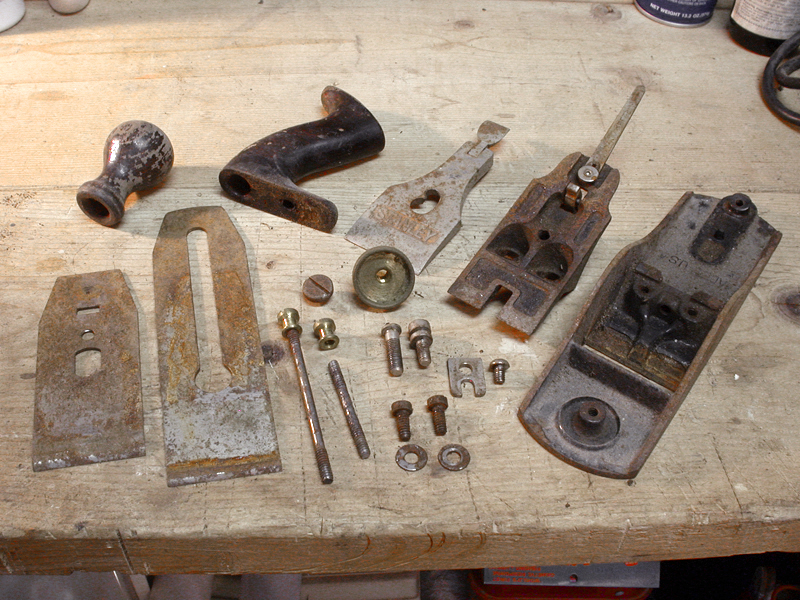
Completely disassembled, I clean all the steel nuts and bolts by hand, with special attention made to removing rust from the threads and crud from the slots.  Using a light penetrating oil, I brush all the threads using a fine brass or steel brush – but again, I do this by hand to maintain control and not over clean.   The oil creates a nice barrier for future rust prevention.  I use the same oil to clean each screw hole.  Contact surfaces on the tool where parts mate together are also cleaned by hand in the same manner.  For the brass parts, I clean them using the penetrating oil and toothbrush or nylon brush, taking great care to remove dirt only and not abrade the patina or surface.  The oil is crucial here as it provides lubrication and a barrier against scratching.  Once the dirt is removed, there is invariably a lovely naturally aged oxidized patina found hiding beneath.

Finally, I rub down the japanned and exposed metal surfaces with the LTV concoction.  This dries to the touch, helps retard rust, and looks better than oil or wax. That’s pretty much it.  Tools cleaned in this way retain all of their patina, blemishes, and character, while losing the rust and dirt.  Best of all, nothing in the process is destructive, and other than removing the dirt and rust, the tool is left in exactly the same physical condition as when you started.

Tuning for Use
Whether purchased in 2010, or 1910, many hand tools (and virtually all planes) required some degree of tuning before use.  While it’s debatable as to whether the average journeyman of the last century took the time to do so, it’s nevertheless highly recommended.  Planes in general, and vintage planes in particular, require some attention in order to get the best out of them.  Soles were cast iron, and while milled flat during manufacturing, had a tendency to change dimensions, twist, or warp over time.  The smaller the plane, the more critical this can become, but again, depending on use.  I’m not going into great detail on all the methods used to flatten soles, or debate what is or isn’t flat enough.  Just keep in mind that folks used tools for a couple thousand years without 0.001″ tolerances, and didn’t seem to have any problem.  Basically, if you’ve got a reasonable flat surface to work against (jointer table, glass, or granite), you just progress from larger to finer grits to achieve a flat sole.

Generally speaking, the critical thing with all cutting tools is keeping the blade securely fastened to the tool at the proper angle, and of course keeping the blade sharp.  In fact, a plane is nothing more than a device for holding a cutting edge at the correct angle to shave wood.  On hand planes and spokeshaves, etc. the blade, or iron as it is properly called, is seated against an angled base.  On a plane this base is called the frog, and its angled surface must be flat and free of burs or obstructions that prevent the iron from seating completely flush.  Tuning the frog includes assessing its face and lapping it flat if there are high spots.  Similarly, the milled seating surfaces must also be free of corrosion and mate perfectly with the bed where it attaches.  Adjustment hardware must move freely but also be secure so there is no slop, or unwanted movement.

Finer points of tuning include providing proper flow for shavings.  The leading surface of cap irons should ideally be polished smooth to reduce friction as the shavings pass across it.  The mating edge of the cap iron should also sit completely flush against the iron to prevent shavings from jamming between the two.  Additionally, the lower end of the lever cap should rest flat against the cap iron in order to hold it securely and minimize shavings getting caught underneath.  All other knobs, wheels, and adjustments should be refined and lubricated to work smoothly and easily.

Finally, the single most important aspect of tuning is sharpening.  I would go so far as to say a poorly tuned but very sharp tool will consistently outperform a finely tuned but poorly sharpened tool.  Rather than try to go through the basics of sharpening, I highly recommend you get a good book and invest in a sharpening system that matches your needs and preferences.  Excellent references include the books by Lie-Nielson, Leonard Lee, and Ron Hock.  I will say that unlike most woodworkers who view sharpening as a necessary evil, I actually enjoy it and find it to be quite therapeutic and relaxing.

I realize this guide is by no means comprehensive, but it should provide a good start for anyone looking to restore, preserve, and care for vintage tools.