Understanding Type Studies

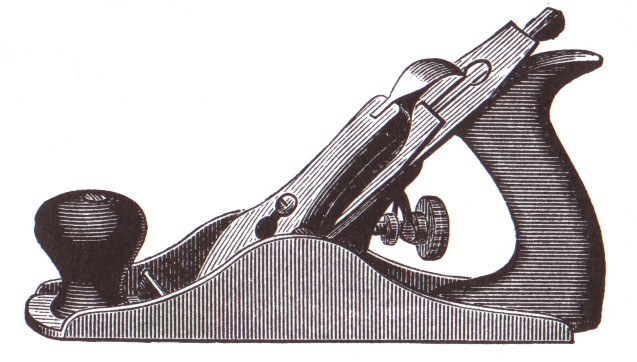
Catalog Image of Stanley Bailey Smoothing Plane, c. 1880sLet’s be honest, Type Studies are confusing to a lot of people, especially those new to tool collecting. One reason for this is that by their very nature, Type Studies attempt to identify very specific points in time that correspond with transitions in the design and manufacturing process of tools made in the past. There are many problems with this.  First and foremost, manufacturers never imagined that anyone in the future might care about tracking changes in the evolution of their designs.  Subsequently, even veterans who know better sometimes lose sight of just how blurry those lines of delineation are along the historical manufacturing timeline.

The first thing to clearly understand is that Type Studies are a present day construct. They were not a production guide used by manufacturers to identify, notate, or track changes in design.  Stanley and their competitors didn’t follow Type Studies.  Why, you ask?  Because Type Studies didn’t exist at the time the tools were made.  Did you get that?  Type Studies are a present day guide.

It was not until the 1970s and ’80s that people really started thinking about collecting vintage hand tools. And it’s only in the last 10 or 15 years, when woodworking with hand powered tools has enjoyed a resurgence, that vintage tool collecting has started to explode in popularity.  The big name hand tool aficionados (Roger Smith, Alvin Sellens, Clarence Blanchard, and others) conducted extensive research, pouring over company records and old catalogs and detailing the physical variations of thousands of tools in order to begin piecing together timelines for various models.

These timelines, delineated by significant and important changes in the design and manufacture of a tool are referred to as Type Studies.  Different ‘Types’ within a Type Study refer to a defined period of manufacture in which a particular set of features was unique.  That said, the change from one Type to another doesn’t mean the entire tool was redesigned.  In fact, virtually all feature changes overlapped others, and a given feature or set of features might extend over several Types.  A good example can be illustrated with the lever caps used on Stanley’s Type 13-15 bench planes made between 1925 and 1932.  While the same design cap was used on all three types, there were other feature changes that delineate the three different date ranges on the Type Study time-line.

Summing it all up, here are five important confusion-busting facts about Type Studies that should provide clarity:

    1. Type Studies are modern-day timelines used to identify the age of a tool by referencing important changes in its design, manufacture, and physical characteristics.  Different ‘Types’ within a Type Study refers to a particular period of manufacture in which a particular feature or set of features was unique.
    2. Manufacturers didn’t adhere to Type Studies because Type Studies did not exist at the time.  They simply manufactured tools and made periodic changes to design and manufacturing processes, just like manufacturers today.  We identify those periodic changes in the Type Study, and subsequently assign ‘Types’ based on the time period in which they were made.
    3. Type Studies are not interchangeable.   They only apply to a specific model or series of tools.  Different tools and different lines will have different Type Studies.  For example, Stanley’s Bailey line of bench planes have a completely different Type Study from the Bed Rock series.   Some tools, like the no. 71 router plane, have their own individual Type Study.  Many tools have never been studied in depth and don’t have a Type Study at all.
    4. Type Studies are approximations.  The manufacturing timeline was constantly evolving.  Even when design changes were made, existing (old) stock parts were used until their supply was depleted before moving to new parts.  Therefore, the changeover of features sometimes took months or even years, resulting in multiple variations of the same product being released at the same time.  While Type Studies imply that these changes were aligned with a specific date or year, collectors need to understand that the transitions were more evolutionary than revolutionary.
    5. Type Studies are not all-inclusive.  With some manufacturers and some tools, and some tools made during certain periods, features and materials varied quite a bit.  A good example of this is Stanley’s offering of Bailey bench planes made during World War II.  Brass was in short supply, and subsequently, the so-called Type 17 planes made during the war years have a variety of inconsistencies.  Some had brass hardware, where others have steel.  Some have rosewood knobs and totes, while others have painted hardwood.  Some have frog adjustment mechanisms while others don’t.   All made during this period, however, are considered Type 17, regardless of features.

***

An Inexplicable Affinity for Low Angle Block Planes

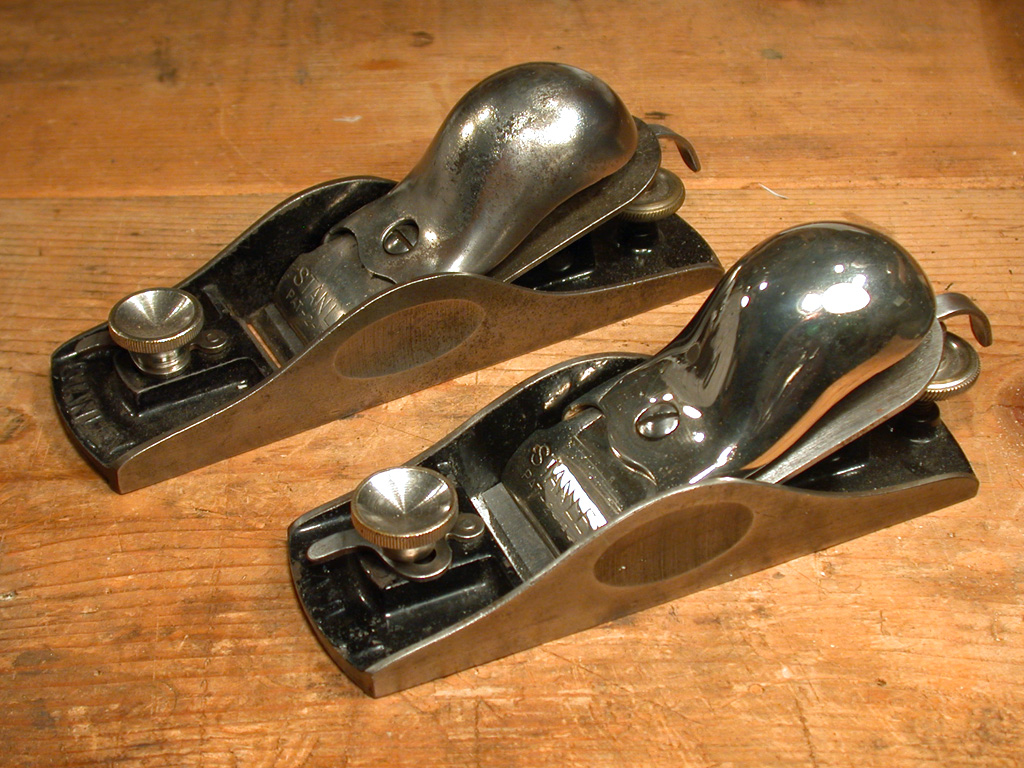
Stanley no. 65, c. 1913-19 (Left), no. 65, c. 1904-13 (Center), no. 65-1/2, c. 1905-10 (Right)

There’s something inexplicably sexy about low angle block planes.  Arguably the more versatile of all the block planes, low angle blocks were not historically the best-selling models in the lineup.  Stanley, and their counterparts at Millers Falls and Sargent (among others), were relatively conservative in their low angle offerings, at least compared to the standard angle variants they made.

If you include their more exotic models, Stanley produced a total of just 8 different variations of low angle block planes:

Model Length Width Adj. Throat Trim
No. 60 6 inches 1-3/8″ iron Yes Nickel
No. 60 1/2 6 inches 1-3/8″ iron Yes Japanned
No. 61 6 inches 1-3/8″ iron No Nickel
No. 62 14 inches 2″ iron Yes Nickel
No. 63 7 inches 1-5/8″ iron No Nickel
No. 64 12-1/2 inches 2″ iron No Nickel
No. 65 7 inches 1-5/8″ iron Yes Nickel
No. 65 1/2 7 inches 1-5/8″ iron Yes Japanned

Setting aside the extraordinary no. 62 ‘low angle jack’ and its oddball (and extremely rare ) short-lived brother, the no. 64, which were only called block planes due the bevel-up orientation of their irons, we’re left with six contenders.  Let’s review them in order…

The no. 60 & no. 60-1/2

Stanley nos. 60-1/2 & 60

The 60 series of Stanley planes includes the no. 60 and the no. 60-1/2.  Both planes are identical in every way other than their trim.  The no. 60, introduced in 1898, featured nickel-plated trim, while the no. 60-1/2, introduced in 1902, had japanned trim.  Just to avoid any possible confusion, the beds were japanned on all Stanley planes.  Trim refers to the lever caps, which came nickel-plated on the no. 60 and japanned on the no. 60-1/2.  Likewise, the knobs and adjustment wheels were nickel-plated on both the no. 60 and the no. 60-1/2. [1]

The ‘Type 1’ version of the no. 60, originally introduced with a rosewood front knob and no adjustable throat plate, was updated in 1902 with a brass front knob and an adjustable throat plate with an upturned eccentric adjusting lever.  Iron width on these planes is stated to be 1-1/2 inches prior to 1913, but I’ve never seen an example of this.[2]  Every one of this vintage that I’ve owned has featured a 1-3/8 inch iron with the J trademark stamp, which is correct for the period and dates from prior to 1909 on block planes (as far as I can tell).

These are my favorites of the low angle block planes.  I prefer their smaller 6 inch length for trimming end grain, an application at which low angle blocks excel.  Additionally, since their beds are set at 12 degrees and their irons positioned bevel up, you have the flexibility of changing the bevel angle to affect a change in the angle of cut.  With its bevel sharpened at the standard 25 degrees, you get a 37 degree angle of cut (12 + 25 = 37).  However, you could reasonably sharpen the bevel at 33 degrees and get a 45 degree cut, the same as a standard angle plane.  With two irons sharpened at different angles, you could conceivably get by with just one block plane for both standard and low angle cuts.

A note of caution… low angle planes are a little more fragile than standard angle planes for two reasons.  First, the angle of the bed is much sharper, making the leading edge (back edge of the mouth) more prone to chipping and cracking, so go easy on them when planing.  Second, don’t tighten the lever cap too much.  It puts a strain on the threads of the depth adjustment mechanism at the rear when you adjust the iron depth.  If it’s too tight, those threads can strip.

The no. 61 & no. 63

Stanley nos. 61 & 63

Introduced in 1914 and 1911 respectively, it appears that neither the no. 61 nor the larger no. 63 were particularly successful for Stanley.  Very few folks were tempted to purchase a low angle plane without an adjustable throat, especially when that feature could be had for just a few pennies more.  Subsequently, their limited popularity constricted demand and production, and so they are fairly hard to find today.  While collectible due to their scarcity, users looking for a functional low angle block are far better off sourcing a no. 60 or 65 in good condition.

Ironically, these planes are virtually identical to the very first type no. 60 and no. 65, both of which were introduced in 1898 with a similar wooden knob and lacking an adjustable throat.  Why then, less than 10 years later, Stanley thought reintroducing this handicapped design under the model nos. 61 and 63 was a good idea is anyone’s guess.  Regardless, both the no. 61 and no. 63 are easily distinguished from the Type 1 no. 60 and 65 since their model numbers were cast in relief at the rear of the bed just below the depth adjustment knob.  Manufactured for less than 25 years, both planes were discontinued in 1935.

The no. 65 & no. 65-1/2

Stanley 1935 Catalog

The 65 series includes the highly regarded no. 65 and less common no. 65-1/2.  Measuring about 7 inches long with 1-5/8″ irons, these planes are the bigger brothers to the 60 series of low angle blocks.

Like the 60 series, the lineage of the no. 65 series is equally convoluted.  Introduced in 1898, the no. 65 was first offered with a nickel-plated hooded style lever cap, wooden front knob, and non-adjustable throat.  The first major change happened in about 1905 when the wooden knob was replaced with the same brass knob used on all the other blocks, and an adjustable throat was added.  The third major change took place around 1913 when the hooded lever cap was replaced with Bodmer and Burdick’s newly designed knuckle joint lever cap, the same that was updated on the no. 18 and no. 19 standard angle planes.  50 years later, in 1964, the lever cap was changed back to the hooded type found on the no.  9-1/2, before the plane was discontinued altogether in 1969.

Considered one of the best block planes Stanley ever made, the no. 65 is sometimes referred to as the ‘Cadillac’ of block planes by vintage tool enthusiasts today.  While I prefer the smaller no. 60, the no. 65 is indeed an exceptionally well designed plane and a pleasure to use, using the same care considerations noted above for all the low angle blocks.

The no. 65-1/2 version is a bit of an oddball, at least in my opinion, in that it retained the original japanned hooded style lever cap throughout its entire lifespan.  While I don’t see nearly as many of them as I do the more popular no. 65, they were certainly made for a very long time (1902-1950).

There appears to be some inconsistencies in some very reputable published references, which imply that the 65-1/2 was offered with nickel trim.  I don’t believe this was ever the case.  Stanley catalogs from back in the day all list the no. 65 as having nickel trim and the no. 65-1/2 with japanned trim. It’s a little hard to see, but click on the image above to view a page taken from Stanley’s 1935 catalog.  Center left on the page lists the no. 60-1/2 and no. 65-1/2 together, both with japanned trim.

_____________________________
1. Depending on the reference, it appears that Stanley might have used both polished brass and nickel-plated knobs and adjustment wheels at various times.  While it is very common for the nickel plating on these parts to be well worn, I’ve seen enough examples both with traces of nickel and others with no trace whatsoever that lead me to believe that Stanley wasn’t always consistent across models.

2. Walter, John, Stanley Tools: Guide to Identity and Value, 1996.

***

Tools shown in the photos were returned to functional condition by Virginia Toolworks using museum quality archival preservation techniques.  Sharpened and tuned for use, every tool is fully tested and adjusted until perfect.

Stanley’s Uncommonly Magnificent ‘Other’ Block Planes

Mention ‘block plane’ to the average person, and they usually think of the basic Stanley no. 110 or 220, or a competitor’s clone of the same design. These were, generally speaking, the handyman’s plane of the day, and worked just fine for occasional projects such as trimming the edge of a sticking door or window. However, those who worked with tools for a living typically used one of the more versatile models, such as the very popular no. 9-1/2 or the exceptional no. 18, both all-purpose, standard angle planes preferred for their adjustable throats and greater precision. [1]

Stanley missed no opportunity to make a dollar, and offering variations of their more popular planes was clearly an important factor in their strategy to dominate the industry.  They offered more models and trim-lines than you could shake a unplaned stick at.  Many, however, were only moderately popular and relatively shorter-lived, at least compared to the mainstay models that virtually every woodworker had in his tool box.

While the no. 9-1/2, and to a somewhat lesser extent the no. 18, enjoyed considerable popularity, Stanley also offered variations of both of these planes that, today, serve to confuse and confound new users and collectors of vintage tools. Unfortunately, Stanley’s incomprehensible numbering system did nothing to help matters, back then or now. To bring some clarity to the whole matter, here’s a brief breakdown of the variations of these two very popular models, the Stanley nos. 9-1/2 and 18.

The Stanley no. 15

no. 15 & no. 17, c. 1901-07

The no. 15 is identical to the no. 9-1/2 in every way except length – it’s approximately 7 inches long.  It had one of the longest runs of all adjustable throat Stanley block planes, in production from 1876 to 1955.  Given the plethora of size variations and years of production, Stanley clearly found a market for larger block planes, although the no. 15 was nowhere near as popular as its shorter brother.  Subsequently, they are less common on the vintage tool market today and usually fetch higher prices.

The Stanley no. 16

no. 9-1/2 & no. 16, c.1904-09

This plane is the fraternal twin brother to the no. 9-1/2. Like the no. 9-1/2, the no. 16 was approximately 6 inches long with an iron (blade) width of 1-5/8 inches.  The only difference was that its hooded lever cap, front knob, and rear wheel were tricked out in polished nickel, whereas the cap on the 9-1/2 was japanned and the knob and wheel polished brass. The no. 16 was manufactured from 1888 to 1941.

The Stanley no. 17

This plane is to the no. 15 what the no. 16 is to the no. 9-1/2.  Got that?  Simplified, it’s the nickeled out version of the no. 15.  Since the nickel versions of Stanley planes originally cost more than their japanned counterparts, only those woodworkers with the discretionary wherewithal purchased them.  I don’t see a lot of these planes out in the market, leading me to believe they were not all that popular.  I guess selling bling during the 1930s depression was difficult.  Just like the no. 16, the no. 17 was manufactured from 1888 to 1941.

The Stanley no. 19

no. 19 & no. 18, c. 1913-19

If there was a market for a 7 inch version of the no. 9-1/2, then logically there would be a market for a 7 inch version of the no. 18.  The number 19 is just that.  Sharing the same nickel plated knuckle jointed lever cap evolution as the no. 18, and the same 1-5/8 inch cutter used on all these planes, the no. 19 is identical to the no. 18 in every way except length.  It was made from 1888 to 1949.

Summing it up…

The no. 15 is the 7 inch version of the no. 9-1/2
The no. 16 is the nickel version of the no. 9-1/2
The no. 17 is the nickel version of the no. 15 (and/or the 7 inch version of the no. 16)
The no. 19 is the 7 inch version of the no. 18

I suppose if you have extra big meat hooks, the larger planes might feel better in your hand.  And if you like your planes tricked out, nickel-plated lever caps and hardware will help pimp your work bench.  But other than length and bling, these planes are all pretty comparable to their better known counterparts, although they do tend to command higher prices since they are less common. Collectors will already know that, but for those of you looking to pick up your first or second user, hopefully this clears up the confusion.

[1] Standard angle refers to bed angle of 20 degrees.  Sharpening the standard 25 degree bevel on the iron provides a cutting angle of 45 degrees, the same as bench planes.  Low angle planes had 12 degree beds for a cutting angle of 37 degrees.

***

Tools shown in the photos were returned to functional condition by Virginia Toolworks using museum quality archival preservation techniques.  Sharpened and tuned for use, every tool is fully tested and adjusted until perfect.

Setting Up and Tuning a Hand Plane

In today’s culture of instant gratification and disposable everything, most of us are conditioned to expect the stuff we buy to just work right out of the box.  Even the caveat “some assembly required” is printed on the packaging of many items, just to make sure there is no misunderstanding.  Published reviews of shop tools invariably dedicate an entire section to the experience of unpacking, cleaning, and setting up the tool for use, before the subject of functionality is even broached.  Whether a realistic expectation or not, once a tool is put together, most people want no further inconvenience beyond plugging it in and turning it on.

It’s no surprise that so many ‘modern’ woodworkers, especially those used to plug-and-play electric tools, eschew anything that requires sharpening, let alone tuning and fettling to make it work properly.  But the fact is, whether 100 years old or brand spanking new, virtually all hand planes benefit from some degree of tuning to bring them to their full potential.  Fortunately, this is not a difficult proposition, and actually aids in better understanding how the tool functions and how to get the most out of it.

Below are the basic steps for setting up and tuning a hand plane for use.  Since there are so many variations of planes, both new and used, I’m purposefully keeping it fairly generic, so some interpretation may be necessary when applying the concepts to the tool in front of you.  But don’t worry, there are no tool police surveilling workshops and garages.  Feel free to skip a step if you don’t think it’s relevant or needed.

Step 1 – One Righteous Sole
I’m not a stickler when it comes to flattening the sole of a plane.  After owning hundreds and using dozens over the years, it’s fairly rare to come across a plane with a sole so warped, cupped, or bowed that it’s unusable.  If you happen upon one that is unusable, my advice is to return it, sell it, or throw it away.  The only possible exceptions are block planes, which are pretty easy to flatten due to their smaller size.  Bench planes are far more difficult, especially the larger ones.  You can take them to a machine shop and have them milled or lapped flat, but forget trying to flatten them yourself with sandpaper unless the problem is very minor.

Good luck trying to lap this 22″ bad boy!

If you do decide to lap your plane’s sole flat, you’ll need a dead flat substrate.  The cast iron bed of a table saw or jointer works well, or if you don’t have one of those available and want to keep it on the cheap, a piece of 12” x 12” or larger granite surface plate or a marble tile from your home center will work for block planes, and typically costs less than $5.00.  Just make sure you retract the blade and tension the lever cap as you would in actual use.  This puts the correct stress on the plane body.  I start with 60 grit and progress up to about 320.  Removing high spots (convexity) is more critical than low spots (concavity).  Keep in mind that you don’t even need the entire sole dead flat.  As long as you have smooth contact at the toe, around the mouth, and at the heel, the plane will work just fine.

Vintage planes often have raised dings, especially along the edges, toe or heel.  A flat mill file makes very quick work of these minor problems.  Finally, some woodworkers file a very small 45 degree chamfer along each edge of the sole.  This is completely optional, but helps prevent inadvertent gouges when using the plane should you tip it slightly.  I’ve seen some Stanley planes from the mid 20th century that appear to have been made that way at the factory.

Step 2 – Flat Frogs Make Better Mates
Bench planes have removable frogs.  Block planes do not.  However, the function of the frog is the same – it provides a secure base to support the iron.  In order for the plane to shave wood correctly, there must not be any movement (wobble, play, rocking, etc.) to the iron.  It must be firmly seated against the frog, so the face of the frog must be as flat as possible.

On your bench plane, unscrew and remove the frog and all of its hardware, including the lever cap bolt on the front and the adjustment plate and screw on the rear.  Taking care not to damage the tip of the yoke that engages the iron and cap/iron, carefully sand the face surface of the frog until it is as flat as possible. I use the edge of my granite block for this, and change direction often to ensure I get a surface as flat as possible.  No need to obsess over it, you just need the iron to seat firmly against it.  While your at it, touch up the mating surfaces on the bottom of the frog where it attaches to the plane base.  Also take a moment to touch up the mating surfaces on the plane body too.  You want the frog to seat as firmly as possible to the body.
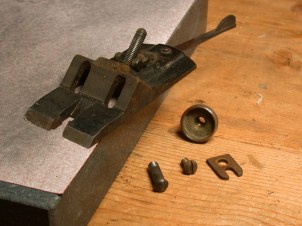
Lap frog face on edge of stone to protect yoke

On vintage planes, thoroughly clean all the threads of the screws and bolts to remove any crud or rust, and apply a little light oil before reassembly.  This is particularly important for the large brass adjustment knob, which needs to turn freely along the full length of its bolt.

On your block plane, the frog is not removable, so you only need to touch up the seat with a firm sanding block to ensure it is flat.  Since the flat sloped area behind the mouth on the plane’s base provides much of the forward support for the iron, it needs to be flat too.  Unfortunately, it’s hard to get to, and since you don’t want to enlarge the mouth at all, just a touch using a small piece of angled wood with fine sandpaper wrapped around it is about as far as you want to take it.  Thankfully, this is all that is usually needed to remove old crud. A Dremel or quality flexible shaft tool with a wire wheel brush will also work if the problem is limited to dirt and light corrosion.  Finally, as on the bench plane, clean the threads on all the hardware and add a little light oil to help retard moisture and rust.

Step 3 – Chip Breakers, not Deal Breakers
On bench planes, the chip breaker, more accurately referred to as the Cap Iron, serves three important purposes.  1. It adds rigidity to the iron (blade). 2. It provides a small opening through which the depth adjustment mechanism engages the iron.  3. It helps ‘break’ the shavings as they rise off the cutting edge of the iron, thus preventing them from jamming up the throat of the plane.

Most cap irons, even on new planes, benefit from a little tuning to make them more efficient.  The leading contact edge, where it rests upon the edge of the iron, needs to be completely flat so that no light (or shavings) can pass between the two.  This is a simple matter of a couple of passes on a sharpening stone.  I use my 1000 grit stone as anything higher is overkill.  If you don’t have one, use whatever comparable sharpening media you have available.  Ideally, you should undercut it slightly, so just the front edge makes initial contact.  As you tighten the cap iron against the iron, it will flatten out some.  The idea is to make it completely flush so that fine shavings do not slip in between the cap iron and iron.

Cap iron with polished arch

The other tuning point on the cap iron is its forward arch.  For lowered resistance and smooth chip passage, this arch should be polished.  You can do this by hand using your sharpening stone or sandpaper.  Again, 1000 grit or thereabouts is enough.  Smoother is better, and there’s no downside to over-polishing other than the time it takes.  Once complete, you may need to remove any burr that has formed along the front edge.  I run mine edgewise (like cutting with a knife) down a piece of scrap wood.

Note that block planes do not have cap irons.

Step 4 – Pop a Lever Cap on that Sucka
While appearances and designs vary greatly, all planes have some sort of lever cap.  The lever cap provides the tension that holds the iron in place.  There’s not really a whole lot that needs to be done to the lever cap.  Just ensure that the contact edge on its back side is reasonably flat, so it makes flush contact with the cap iron on which it sits.  Wood shavings will find their way through the tiniest of gaps.  If you’re obsessive, you can polish the forward arch a little just as you did with the cap iron.  You might also add a drop of oil to the working joints to ensure smooth operation.
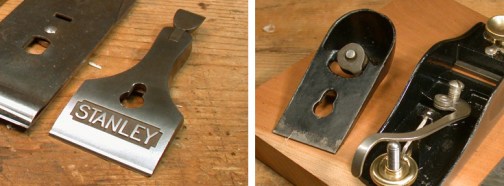
Bench plane and block plane lever caps

On block planes, since there is no cap iron, the lever cap plays a more important role.  Take a fine file to the back side and remove any rough spots, giving close attention to the leading contact edge.  This is most important on block planes with cast iron hooded style lever caps, such as the old Stanley 9-1/2.  The back sides of these caps are notoriously rough and unfortunately japanned. You don’t need to remove all the japanning, but you do want to get a smooth line of contact down front where it touches the iron.  File it smooth and give it a couple of swipes across your 1000 grit stone.  I like to touch up the top front edge as well, but this isn’t critical.

Step 5 – I Pity the Fool Who Don’t Sharpen His Tool!
The simply fact is, even with brand new planes, the irons require final honing before use.  This is not due to some lack of attention on the part of manufacturers.  Irons are provided this way on purpose, since the manufacturer has no way of knowing what you will be using the plane for, and subsequently how the iron would need to be honed.  If you do nothing else in the way of tuning your plane, at least take the time to properly sharpen it.  Do not skip this step!  Sharpen the iron.  Again, sharpen the iron!  Sharpen it!

Basic sharpening setup using a waterstone

Since sharpening is such an expansive topic in and of itself, I will leave the specific details for other posts.  What you need to know in the context of tuning, however, is that any plane, new or old, requires initial sharpening and honing.  At a minimum, new plane irons need to have their un-beveled side honed flat and polished to at least 4000 grit and preferably 8000 grit.  You don’t need to fuss with the entire surface; just the first 1/8” to 1/4” along the cutting edge will do.  You also need to put a final honing on the bevel edge itself.  It may look sharp, but it needs to be honed, again, to at least 8000 grit.  The goal is to get your cutting edge to as close as possible to a zero degree radius.

Sharpening is too often the deal breaker that dissuades woodworkers from trying hand tools.  This in unfortunate, for it requires little monetary investment to get started, is not particularly difficult to learn, and can be accomplished rather quickly with surprisingly good results.  For detailed information on sharpening, I recommend investing in one of the outstanding books on the subject by Ron Hock or Leonard Lee.   Chris Schwarz has also written a number of fantastic articles on sharpening plane irons. Sharpen the iron.  Again, sharpen the iron!  Sharpen it!

Step 6 – Final Adjustments
Now that you’ve finished tuning and sharpening your plane, it’s time to put it all back together and adjust it for use.  Hopefully, you have a better understanding of what each part does and how they all function together.  This will make adjusting it for use, and while in use, more intuitive and fluid.

A few points of consideration…

While the frog’s position on bench planes is adjustable, meaning you can shift if forward to decrease the size of the mouth opening or backward to increase the size of the opening, it needs to be firmly attached in whatever position you decide so that it doesn’t move when in use.  In other words, to adjust its position, you will have to loosen the screws that attach it to the base.  Without getting into detail, use a larger mouth opening for thicker cuts, and a smaller mouth opening for fine shavings.  Set the position of the frog where you want it and screw it down tight, understanding you may need to do this a couple of times before you get to just the right position.

The cap iron should be firmly screwed to the iron, leaving just a tiny edge of the iron protruding forward.  This should generally be as small as possible – 1/64” for fine shavings to 1/16” or more for heavier cuts, depending on the amount of camber on the iron. The iron/cap iron in place, the lever cap bolt should be tightened just enough to hold the iron firmly so it doesn’t slip in use, but not so tight that you can’t adjust it’s depth of cut using the large brass or steel wheel at the rear of the frog.  If that knob won’t turn, the bolt holding the lever cap is too tight.  This too, may take a couple of tries before you get the feel of it.

Holding the plane upside down, and looking down the sole at a low angle, lower the iron until it just begins to appear through the mouth – just a whisper.  Note that it’s not unusual for there to be quite a bit of slop in the wheel that lowers and raises the iron, as much as ½ to ¾ of a turn.  Just turn it until you begin to feel resistance.  Make any lateral adjustments necessary using the lateral adjustment lever that extends from the top of the frog.  Turn it upright and make a test pass on a piece of scrap wood.  If the plane digs in, back off the depth just a bit.  If it misses entirely, lower the iron a little.  You will quickly get a feel for when it’s ‘right,’ as evidenced by the rewarding ‘thwack’ sound a plane makes when it cuts a perfect curl.

On block planes, adjustments for use are a simple matter of properly tensioning the lever cap and setting the throat opening via the front adjustment plate (if the plane has one).  The same principles apply that you use in adjusting your bench planes.

Tuning a hand plane is not a difficult endeavor.  Once practiced, the whole process can be accomplished in about a half hour, even less depending on the tool.  Rather than view it as an unpleasant chore, I actually enjoy it, especially later in the evening when the dust has settled and the world is quiet.  Pour yourself a measure of Kentucky’s best brown, put on your music of choice, and saddle up to your work bench.

Stanley no. 5 Jack Plane, c. 1940s

***

Tools shown in the photos were returned to functional condition by Virginia Toolworks using museum quality archival preservation techniques.  Sharpened and tuned for use, every tool is fully tested and adjusted until perfect.
Two Block Planes Everyone Should Own

I have a weakness for block planes.  They are the two seater sports cars of the hand plane world – quick, nimble, and fun to handle.  Heck, from the classic lines of Stanley Excelsiors 130 years ago to the high performance Veritas planes of today, they even look fast.  (Both shown below)

I have a sizeable collection of block planes that includes some of the rarest and most beautiful ever made.  Those, of course, are now relegated to display, as their value precludes risking damage in use.  But the vast majority in my collection are sharp and ready to use, and I do exercise each of them periodically when I’m working on a project.  This helps keep them in working order, and it just makes me feel good.

Still, over time I’ve found myself unconsciously reaching for the same couple of planes whenever the need arises.  If I were forced to reduce my toolbox to just two block planes, these are the two I would keep:

The Stanley No. 18 Standard Angle
The Stanley No. 60 Low Angle

Stanley no. 18, c. 1913-19

The Stanley No. 18 Standard Angle
This is my go-to block plane for everyday use, the one I always seem to grab first.  Mine is a very pristine WWI era model that I’m pretty sure I’ve used more than anyone else in its history.  Although it’s almost 100 years old, it looks like it could have been manufactured last year.  Both the japanning and nickel plating are pushing 100%, and so I baby it.

The Stanley no. 18 is a standard angle plane, meaning the iron is seated on a 20 degree bed.  With a bevel angle sharpened at the standard 25 degrees, you have a cutting angle of 45 degrees, same as a bench plane.  It also has an adjustable throat plate, an essential feature in a block plane.  The no. 18 is 6 inches long and fits my hand better than its longer, otherwise identical 7 inch brother, the no. 19.  And unlike the more popular Stanley no. 9-1/2, it feels more like an extension of my hand.

The no. 9-1/2 plane predates the no. 18 by about 15 years, was in production longer, and was the best selling block plane Stanley ever made.  It’s still made today, in fact, although the current design features a completely different mechanism from the original.  Admittedly, the no. 9-1/2 was the more popular of the two.  I truly don’t know why, though, since the design of the no. 18’s knuckle cap was far superior to the hooded lever cap on the no. 9-1/2, and it’s also more comfortable to hold in the hand.  I also find that the hooded cap on the no. 9-1/2 is more prone to slip around a little in use.  Not so with the no. 18.

Ironically they are both basically the same plane with two different styles of lever caps.  Other than the lever cap and its mounting bolt, all the other parts are interchangeable. Stanley charged a little more for the no. 18 and marketed it as virtually indestructible.  This of course was not true, for while the steel cap is arguably more durable, the bodies of both were cast iron and therefore susceptible to breaking if dropped.

I have several vintages of both models in my collection, but find the no. 18 with the knuckle cap superior in both function and comfort.  I use this more often than any other block plane I own.

Stanley no. 60, c. 1910

The Stanley No. 60 Low Angle
The Stanley no. 60 (and the identical japanned version 60-1/2) is a low angle plane, meaning the iron is seated on a 12 degree bed.  Sharpened at 25 degrees, you have a cutting angle of 37 degrees.  The primary advantage of the lower angle of attack is that it excels at shaving end grain.

Like the no. 18, the 60 series of planes are approximately 6 inches long.  However, the 60 series are narrower with an iron width of 1-3/8 inches, vs the 1-5/8 inch irons on the standard angle planes, and the 60 series featured a narrower version of the hooded lever cap used on the no. 9-1/2.  The 60 series planes also have adjustable throat plates.

As with the standard angle planes, Stanley made another low angle plane that was more popular than the No. 60.  The no. 65, which was wider and longer, is even today considered by many to be the ‘Cadillac’ of Stanley block planes.  I have a couple of no. 65s, which I use occasionally, but I prefer the no. 60 for its smaller size.  The size of the no. 65 makes it feel a little awkward to me for most projects, although it excels on wider boards and edges where the no. 60 is too small.

Most people are familiar with the knuckle jointed lever cap on the no. 65, the very same cap used on the nos. 18 and 19 standard angle planes.  It’s interesting to note that the no. 65 was originally made with the hooded style cap until about 1917 when Stanley switched to the knuckle jointed steel cap.  I’ve never quite understood why the no. 65 is so highly regarded.  Being 7 inches long, I find it a little too big in the hand.  The no. 60 series planes are smaller and much easier to handle, and ironically, I never found their hooded cap to be problematic as I do with the no. 9-1/2.  So, maybe it’s just me.

Ultimately, that’s the point.  I had to try all of the various models and sizes until I found what I liked best.  On all of these block planes, the iron is seated bevel up, whereas on bench planes the bevel is usually down.  There is a tremendous advantage with bevel up irons in that the angle of the bevel can be changed to affect a change in the angle of cut.  While there is more to consider in edge geometry than just the angle of cut (ex. durability), you could reasonably sharpen the bevel on a low angle plane iron to 33 degrees and end up with an angle of cut of 45 degrees (12+33=45), the same as on a standard angle plane.  However, to accomplish a low angle of cut using a standard angle plane, you’d have to sharpen the bevel at a very shallow 17 degrees (20+17=37).  Durability of such a thin cutting edge would be problematic with most woods.

For this reason, along with a few others, many people consider the low angle plane to be the more versatile of the two.  I tend to agree.  While I use my standard angle plane more often, if I could only have one block plane, it would have to be a low angle.  Fortunately, despite what my wife says, that’s not the case.

The no. 18 and no. 60 are my two primary go-to block planes when I’m working on a project.  I have most of the other Stanley sizes in my collection, and like I said, I’ll pick them up to use sometimes just for nostalgia, but the nos. 18 and 60 are my favorites. These are the two that I think everyone should own, but ultimately, you won’t know which you prefer until you try a few for yourself.

***

Vintage tools shown in the photos were returned to functional condition by Virginia Toolworks using museum quality archival preservation techniques.  Sharpened and tuned for use, every tool is fully tested and adjusted until perfect.