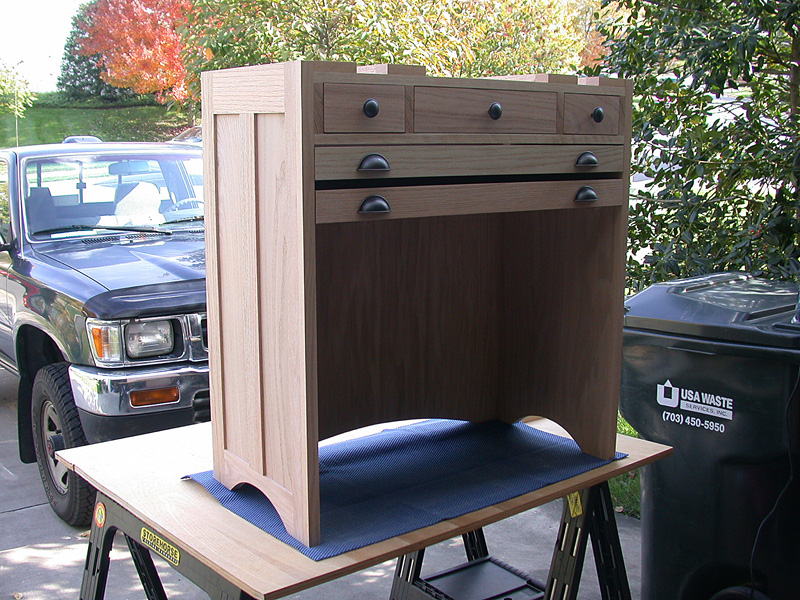
Greatest Table Saw Quote Ever

I was doing some research today and ran across the following quote on sawmillcreek.org by a guy named Jonathan McCullough.  Dating back to 2010, it is quite simply the grandest description I’ve ever read of the table saw beast, and I thought it too good not to share.  So Jonathan, whoever you are and wherever you are, here’s to you!

“I wish someone would pop up at my door with a pickup truck saying how much they wanted a table saw.  No doubt. Mine is powerful, well tuned, has all sorts of doodads, and I hate it. Hate It. It’s dangerous and spews out a choking cloud of microfine particles. It dominates the garage like a cast iron miasma of self reproach, with tendrils reaching out and stinking up the place with all sorts of jigs and crap that take up even more room.”

 ***

Tune Your Block Plane Tonight

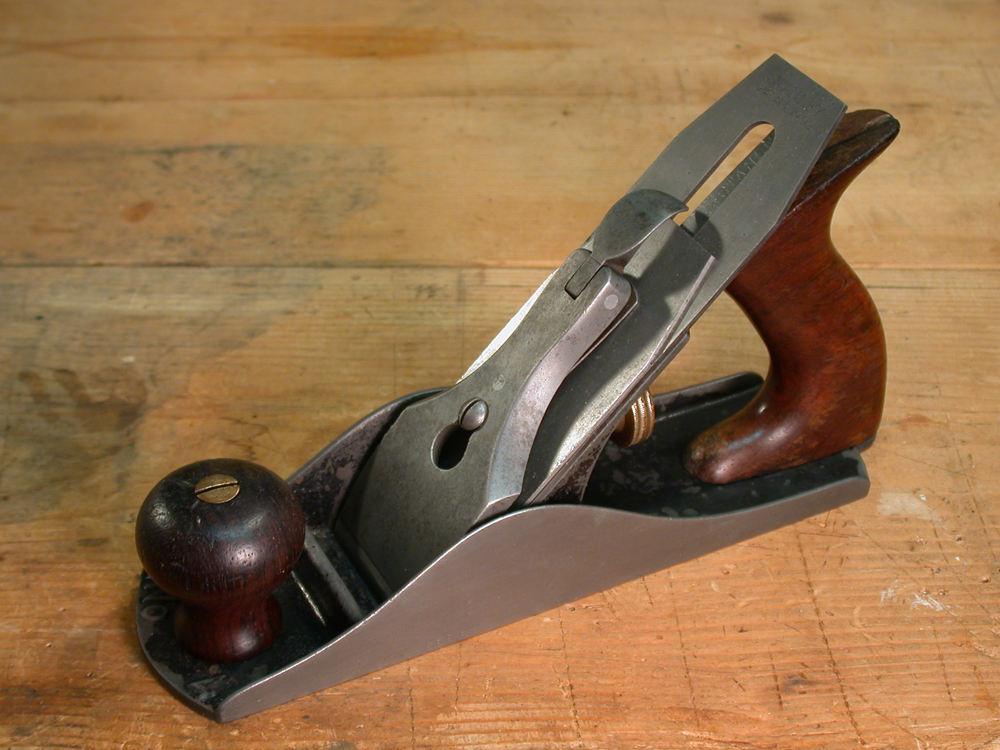
Following the popularity of the recent post, Tune Your Hand Plane Tonight, let’s now talk about block planes.  Much of the information will be the same, but block planes are different enough to warrant a dedicated set of instructions.  Besides, since there are probably more block planes owned today and sitting unused in garages and workshops than there are bench planes, they deserve a little love of their own.

As I’ve written before, I have a particularly strong affinity for block planes.  They are  the sexy two seater sports cars of the hand plane world – quick, nimble, and fun to handle.  But more than that, they are extraordinarily versatile and practical for many handy-man chores around the house, as well as indispensable tools in the wood shop.  Even the most ardent power tool user, and certainly the average homeowner, should have at least one or two block planes in his or her arsenal.

Keeping a block plane in good working order is quite easy.  Tuning one for optimal performance is a simple proposition that can be accomplished in an hour or so, if not less.  As I did with the bench plane instructions, I’m going to assume that your block plane is already in a mechanically functional condition and doesn’t require a full blown restoration.  For that level of detail, I recommend reading the posts under Preservation on the menu bar at the top of the page.  Since there are multiple mechanical styles and configurations of block planes, I’m going to try to keep it fairly generic, so you may need to interpolate for your specific plane.

Step 1 – Pour Drink of Preference

High-West-WhiskeyFor working on block planes, let’s go with something a little more exotic than the bourbon we enjoy with our bench planes.  I recommend Rendezvous Rye from the High West distillery.  It is… complex and superb.  Of course, what you drink is up to you, but moderation is certainly recommended, for while you won’t be working with electrically powered tools, you will be handling very sharp objects.  (5 minutes)


Step 2 – Disassembly & Cleaning

064 SB9.5 -Type 18 Post8The second step is to completely disassemble your plane and clean all the parts.  Using screwdrivers of the appropriate size, remove all the parts – lever cap, cap bolt, lateral lever, eccentric lever, adjustment screws, knobs, etc.  If you’re not completely familiar with what and where everything goes or are worried you might have trouble putting it all back together, take before pictures or notes.

Once disassembled, brush off all the sawdust and dirt.  If the filth is excessive, use a toothbrush and orange degreaser (available at the hardware or grocery store).  Also take a few minutes to clean the threads and slots on all the screws and bolts.  I use a small wire bristle brush with a little turpentine or light penetrating oil like WD-40. Once cleaned, wipe them down and set them out of the way so they don’t attract grit.  (10 minutes)

Step 3 – Hello Froggy

160 SAR5306 Post7Unlike frogs on bench planes, the frogs on block planes are usually fixed platforms cast into the body of the plane.  The top of the frog provides a small platform for the iron to sit, while the flat area behind the mouth offers support near the cutting edge.  Both surface areas should be clean of dirt and debris.  A toothbrush or brass bristle brush with degreaser works well, although you can also use WD-40 or turpentine.  The face of the frog is one of the more critical surfaces of the plane.  Once clean, fit the iron against the frog and verify that it sits flat and securely with no wobble.   You don’t want any wiggle or movement, so any high spots or irregularities in the casting need to be carefully filed or sanded flat.   (5-15 minutes)

Step 4 – Adjustimability of the Mouth

165 SB9.5 Type 12 Post7Many “premium” models of block planes feature an adjustable mouth opening.  This typically means the front section of plane’s sole is a separate piece than can be positioned toward the toe (thus opening the size of the mouth) or closer to the iron (closing the size of the mouth opening).   It is necessary to periodically remove this piece to clean out sawdust that has accumulated, and to clean and lubricate the tracks upon which the plate rides.  If it doesn’t adjust easily forward and back, it needs attention.

Since you’ve already disassembled the plane, make sure both the plate itself and the receiver in which it sits are both clean of debris.  Brush the edges of the plate and tracks of the receiver with a brass or wire bristle brush lubricated with light oil or turpentine.  Fit the plate in place and verify that it moves fairly freely.  It is not normally necessary (nor desirable) to sand the edges of the plate to make it move more easily, although this is sometimes necessary if the plane is vintage and the plate a replacement.  If you decide metal removal  is absolutely necessary, be careful and go very slow.  You can’t un-sand.  (5-15 minutes)

Step 5 – Inspect the Sole

165 SB9.5 Type 12 Post5Take a look at the sole (bottom) of the plane.  Inspect for dents or dings with raised points around the edges that might dig into your wood surface when planing.  If you find any, carefully file them flat with a mill file, followed by a little 220 grit sandpaper.  Unlike bench planes, which have a lot more surface area, flattening the sole of a block plane is a relatively painless process.  Although not usually a critical requirement, flattening the bottom will often provide superior results in use.

First, temporarily re-install the iron and lever cap and tighten to normal pressure.  This ensures the body will be under the same stress (and any possible distortion) as when in actual use.  Working against a dead flat substrate such as a granite sharpening block or the iron bed of a table saw,  start with 60 grit and go through progressively finer grits until you are satisfied that the toe, heel, and areas just in front of and behind the mouth are all completely flat and smooth.  I usually stop with 320 grit.  Aluminum Oxide sandpaper is my preference. If you don’t want to invest in a granite sharpening block, granite floor tiles from your local home center are just the right size and cost around $5 each.  (30-45 minutes depending)

Step 6 – Time to Sharpen
Sharpening SetupYes, sharpening is the step everyone loves to hate, the step that prevents so many people from ever trying a hand plane.  The trick is not to wait until you need to use the tool.  Make time for sharpening in advance, and make a party out of it!  Okay , so maybe not a party, but there is something truly rewarding about getting an edge you can shave with.  It’s relaxing and I really do enjoy it.  Since this is not a sharpening tutorial, I’ll leave the particulars on methodology to another post or reference.  But if you do nothing else, take the time to put a keen edge on your plane’s iron.  A 25 degree bevel works perfectly on most block planes – both low angle and standard angle models.  The angle of the plane’s bed varies on these models, usually either 12 degrees for low angle planes or 20 degrees for standard angle planes.  Add the 25 degree bevel and you end up with a 37 degree low angle of cut, or a 45 degree standard angle of cut (same as bench planes).  Add a micro bevel if you want, and don’t forget to polish the unbeveled back edge. (30 minutes)

Step 7 – Lubrication

Pure Oil 1Lubrication is a good idea, but should be done sparingly since oil attracts dirt and grit.  I add just a drop of light oil to the threads of all the bolts and screws before re-installing them.  I also add a drop to all the moving/adjustment parts, but wipe them with a rag afterward so that only a light film is left.  They certainly don’t need to be dripping.

Some guys believe in waxing the sole.  Nothing wrong with that as long as you don’t use a silicone based wax.  However, I just wipe down all exterior surfaces with a little Jojoba oil for storage.  (5 minutes)

Step 8 – Assemble, Adjust, Cut

187 SB18 Type 14 Post1Time to put it all back together.  Re-attach the eccentric lever and front plate (if it has one), adjustment wheel, lateral lever, knobs, etc. and all related hardware.  Carefully put the iron and cap iron assembly in place being careful not to fould the newly sharpened edge, and install the lever cap.  It should lock down securely, but not so tight as to inhibit raising and lowering the iron.  Adjust the front plate (if it has one) forward or backward as needed for the type of planing you intend to do (again, see open vs closed mouth).  Once set, lower the iron into the mouth to take your first test cut.   All of your hardware and adjustment mechanisms should move freely and smoothly. (10-15 minutes)

Unless you run into an unexpected problem, the entire tuning and sharpening process can be completed in about 1 to 2-1/2 hours, and even quicker if you’re tuning a new plane or re-tuning a plane that has already been tuned or well cared for.  It’s easy, rewarding, and builds both knowledge and confidence in your ability to master hand and block planes.

***

Tune Your Hand Plane Tonight

Among the most frequent web searches that lead people to this site come from those looking for information on tuning a hand plane.  Admittedly, for those new to the craft, or at least new to using hand tools, the prospect of setting up and fine tuning a hand plane is daunting.  After all, the nomenclature of parts is bewildering, the functional mechanics are an exercise in geometry and physics, and then there’s that whole issue with sharpening.  It’s no wonder so many people would rather spend an evening prepping for a colonoscopy.

But yea I say unto you, fear not!  Tending to a neglected (or new) hand plane is both relaxing and rewarding, and in most cases takes just an hour or two.  Best of all, the gratification is instant, the rewards immediate.

Now in the interest of keeping things simple, I’m going to assume that your plane is already in a mechanically functional condition and doesn’t require a full blown restoration.  For that level of detail, I recommend reading the posts under Preservation on the menu bar at the top of the page.  I’m also going to focus solely on bench planes.  I’ll cover black planes in a later post.  For simple tuning in one evening, read on…

Step 1 – Pour Drink of Preference

PVW-trio-4What you drink is up to you, and moderation is certainly recommended, for while you won’t be working with powered tools, you will be handling very sharp objects.  I personally prefer a finer bourbon, perhaps Maker’s 46 or Elijiah Craig 18 year, or if I’m in a particularly festive mood, a little Jefferson Presidential Select 17 year or Pappy Van Winkle.  Either way, begin by putting on some relaxing music and have a drink.  (5 minutes)


Step 2 – Disassembly & Cleaning

Disassembled Plane, Ready for TuningThe second step is to completely disassemble your plane and clean all the parts.  Using screwdrivers of the appropriate size, remove all the parts, screw, bolts, washers, etc.  If you’re not completely familiar with what and where everything goes or are worried you might have trouble putting it all back together, take pictures or notes.  Or just pay attention; it’s not that complicated for heaven’s sake.

Once disassembled, brush off all the sawdust and dirt.  If the filth is excessive, use a toothbrush and orange degreaser (available at the hardware or grocery store).  Also take a few minutes to clean the threads and slots on all the screws and bolts.  I use a small wire bristle brush with a little turpentine or light penetrating oil like WD-40. Once cleaned, wipe them down and set them out of the way so they don’t attract grit.  (10 minutes)

Step 3 – Inspect the Sole

Stanley No. 7 Jointer PlaneTake a look at the sole (bottom) of the plane.  Put a straight edge against it if it makes you feel better.  Once you’ve convinced yourself that it’s flat enough (which it undoubtedly is), set it aside and have another drink.  Seriously, after owning hundreds and using dozens of planes over the years, I’m convinced it’s rare to come across one with a sole so warped, cupped, or bowed that it’s unusable.  If there are any dents or dings with raised points around the edges that risk digging into your wood surface, carefully file them flat with a mill file, followed by a little 220 grit sandpaper.  You can also use the sandpaper or steel wool to remove any heavy crud – I suggest lubricating it generously with WD-40, Mineral Spirits, or Turpentine.  Working against a dead flat substrate such as a granite or the iron bed of a table saw is recommended.  Go easy.  No need to overdo it; you just want it to be clean and smooth.  (5-30 minutes depending)

Step 4 – Address the Frog

Lap frog face on edge of stone to protect yokeFirst inspect the seat for the frog on the top side of the plane’s base.  This is the area of contact where the frog attaches to the body of the plane.  The mating surfaces must be clean and flat.   Use a toothbrush with the degreaser.  If there is stubborn crud to be removed, use a brass bristle brush.  If the crud is really bad, you can use a small steel brush, but be very careful to to damage the surrounding finish.  Mating surfaces on the frog itself should also be cleaned in the manner described above.

The face of the frog is one of the more critical surfaces of the plane.  It needs to be as flat as you can get it so the iron sits completely flush against.  You don’t want any wiggle or movement, so any high spots or irregularities in the casting need to be filed or sanded flat.  I go back to my granite surface and sandpaper for this.  Taking care not to damage the tip of the yoke that engages the iron and cap/iron, carefully sand the face surface of the frog until it is as flat as possible.  Change directions periodically to keep it even.  You only need to do enough to ensure the iron sits flat against it.  (15-30 minutes)

Step 5 – Polish the Cap Iron

Cap IronThe leading edge of your cap iron (also called the chip breaker) will need a little attention.  Flatten the leading edge of the cap iron where it contacts the iron so that it seats completely flush against it.  You don’t want any gaps that shavings can slip through.  While you’re at it, polish the top side of that leading edge as well (the hump) to make it nice and smooth.  Less friction makes the shavings pass over it more easily, helping to prevent clogs.   The smoother the better, but don’t obsess over this step.  (10 minutes)   

Step 6 – Sharpen the Iron

Sharpening SetupYes, I know, the step everyone loves to hate.  Even for me, it’s often a task that I procrastinate over, but once I get going, I actually enjoy it.  Since this is not a sharpening tutorial, I’ll leave the particulars on methodology to another post or reference.  But if you do nothing else, take the time to put a keen edge on your plane’s iron.  A 25 degree bevel works perfectly on bench planes; add a micro bevel if you’re into that, and don’t forget to polish the unbeveled back edge. (30 minutes)

Step 7 – Lubrication

Pure Oil 1Lubrication is a good idea, but should be done sparingly since oil attracts dirt and grit.  I add just a drop of light oil to the threads of all the bolts and screws before re-installing them.  I also add a drop to all the moving/adjustment parts, but wipe them with a rag afterward so that only a light film is left.  They certainly don’t need to be dripping.

Some guys believe in waxing the sole.  Nothing wrong with that as long as you don’t use a silicone based wax.  However, I just wipe down all exterior surfaces with a little Jojoba oil for storage.  (5 minutes)

Step 8 – Assemble, Adjust, Cut

Stanley Bailey no. 5, Type 17 - WWII VintageTime to put it all back together.  Re-attach the frog and all its related hardware first, but don’t tighten just yet.   Put the knob and tote back on if you took it off.  Carefully put the iron and cap iron assembly in place and install the lever cap.  It should lock down securely, but not so tight as to inhibit raising and lowering the iron.  Adjust the frog forward or backward as needed until the iron’s cutting edge is positioned appropriately for the type of planing you intend to do (see open vs closed mouth).  Once set, tighten down the frog and lower the iron into the mouth to take your first test cut.   All of your hardware and adjustment mechanisms should move freely and smoothly. (10-15 minutes)

Unless you run into an unexpected problem, the entire tuning and sharpening process can be completed in about 1-1/2 to 2-1/2 hours, and even quicker if you’re tuning a new plane or re-tuning a plane that has already been tuned or well cared for.  It’s easy, rewarding, and builds both knowledge and confidence in your ability to master hand planes.

***

Wait!  What about the tote and knob, you ask?  You can read all about their care and repair right here.

New Old Vintage Planes for Sale

I will be listing several planes and other tools for sale over the next few months.  You can view current offerings by clicking on For Sale on the menu bar.  To view these tools in greater detail or if you are interested in purchasing, please visit the Virginia Toolworks eBay page at http://www.ebay.com/sch/virginiatoolworks/m.html.

***

Save Those Apple Wood Scraps!

Back in the summer I came across some live edge apple wood slabs that I thought might be perfect for making small appetizer serving boards for gifts.  Now I know what you’re going to say – apple is notorious for warping and cracking.  True enough, but given the size and casual nature of this particular project I wasn’t overly concerned.  The working properties of apple, however, is not the subject of this post.

Since these were rough sawn pieces with bark still attached in places, I used what I could, but ended up with a lot of unserviceable scraps left over.  Rather than toss them out, I kept them for use in my smoker.

I’ve long been a fan of using hickory or pecan for smoking pork.  On the few occasions when I’ve smoked beef, I’ve used a little oak or mesquite, although the latter is not my favorite.  Apple chunks are not always the easiest thing to find, and while I’ve heard others extol its virtues for creating irresistible pig pickin’s,  I could not personally attest to the fact.  So when I recently decided to smoke pork ribs for a group of my co-workers, I used apple wood for the first time.

Smoking Ribs

I’m a bit of a purist when it comes to both ribs and pulled pork barbecue.  I use a dry rub (of my own making, of course) and if I’m feeling very generous, might allow a sauce on the side when the meat is served.  I apply the rub at least a few hours before cooking, and then smoke the ribs for 2 hours at 200-225 degrees.  After 2 hours, I baste the racks generously with a mop sauce (sorry, the recipe is my secret), seal them up tight in aluminum foil, and let them bake right on the smoker (so smoke, just heat) for another 2 to 3 hours.

So instead of my standby hickory, this time I used the apple wood scraps left over from the serving boards.  All I can say is “Oh my goodness, I had no idea what I’ve been missing!”  The flavor was much more subtle than that imparted by hickory, and considerably more appealing.  Rather than flavoring the meat so intensely, the apple smoke delicately complimented the dry rub seasoning, resulting in ribs that were perfectly smoky, tangy, and just plain bone sucking, slap your leg and pass the sweet tea good.

My co-workers went nuts over them, claiming them the best ribs they’d ever eaten.  I have to admit, they were easily the best ribs I’ve ever produced on my smoker and among the tastiest I’ve ever sampled anywhere.  Apple wood for smoking pig parts is now my permanent go to.  So save those apple wood scraps, or better yet, ship them to me.  Otherwise, I may need to find my own apple orchard.

***

Whiskey, Guns, & Everything Else…

Here at Virginia Toolworks, woodworking and vintage hand tools are clearly the priority. But the fact is, my passions are varied and eclectic, and I tend to go off on tangents every now and then.  To that end, wood is not the only material I like to work.

For those of you who follow this blog, you’ve probably noticed that I’ve been a little quiet lately.   Silence, however, does not equate to inactivity.  As soon as the summer temperatures moderated back in early September, I dove back into a built-in desk project that I started in the spring.  For a variety of reasons, my woodworking projects are typically executed during the spring and fall, so I plan accordingly.  The winter months are primarily dedicated to tool related projects, restoration and sales.  I use the summer months for research, writing, and other pursuits (hence the title of this post).

The built-in desk is part of an ongoing renovation of my home office.  Completed in late September, I then needed to address another problem that has been looming since November of 2010.  It was at the end of that month, almost two years ago, that my main computer blew a silicon gasket and suffered an unrecoverable death.

Now, in addition to my obsession with woodworking and vintage tools, I’m a computer geek.  Yes, I see the irony of this.  Despite this seemingly unabashed dichotomy, the two worlds do co-exist peacefully.  But I digress.

So, for the last two years I’ve worked off of the “family” computer – the one shared by the wife and kids.  I suppose I could have replaced my office desktop PC at any point along the way, but I preferred to wait until the desk was completed.   I’m not much of a laptop kind of guy, at least not for a primary computer.  I also don’t like buying off the shelf models.  I like building my own.  And that’s exactly what I did in late October.

The new machine is up and running without a hitch, and found a happy home within the new desk cabinetry.  It’s flat out screaming fast with enough horsepower and memory to last 5 or 6 years before needing an upgrade.  As you can see I went with a blue back-lit lighting theme.  Kind of squirrelly, especially for a guy my age, but I like it.

The new Virginia Toolworks Technology Command Center

Now that the desk and computer are built and installed, I can get back to work on the backlog of hand planes and other tools that I will have available for sale starting in January.   I can also get back to dedicating more time to this website.  I have a wealth of reference material that still needs to be added.

As the post title indicates, I’m starting a new category (W. G. & E.) for off topic meandering.  Ramblings might include anything from whiskey to black rifles, or topics not specifically related to vintage tools.  I reckon W. G. & E. sounds better than ‘Misc.’

***

A Lost Fragment of Joseph Moxon

Hysterical parody of Joseph Moxon by Christopher Schwarz; too good not to share!

http://blog.lostartpress.com/2012/10/15/a-lost-fragment-of-joseph-moxon/

Hand Planes for The Rest of Us

A very utilitarian workbench under construction in a less than ideal work space

Seems like most of information related to using hand planes today tends to lean toward the puritanical.  The vast majority of instructional material is written for those planing rough boards straight from a sawmill.  Certainly, there is a good deal of logic behind this.  After all, hand tool purists prepare their wood from the roughest of cuts, be it from saw or froe. For them, the three bench plane model makes complete sense.

That said, there are an awful lot of folks out there in the midst of transitioning from powered to hand tools, and many more who, while using hand tools to some degree of exclusivity, work primarily with dimensional lumber due to constraints of time and available space.  In some cases, a project may include a combination of both.  I often use dimensional lumber for drawer carcasses for example, in order to save time.  The fact is that working rough lumber is not always practical.  I know men and women who are passionate about their craft, but have to move the car out of the garage just to get to the saw horses they use as a bench platform.

Taking a momentary step back, the traditional three bench plane system consists of a Fore Plane, Try Plane, and Smoothing Plane.  Used in sequential steps of coarse, medium, and fine, you can take just about any slab of tree and turn it into a finished board.[1]  Yet while that works perfectly for woodworkers preparing rough cut wood straight from the tree or mill, it doesn’t make much sense for those using dimensional lumber.

Dimensional lumber, of course, is the pre-surfaced wood you find at your local home center, etc.  1x2s, 2x4s and the like are all dimensional lumber.  The wood has been processed through commercial planer and jointer machinery to make it a consistent and standardized size.  And while it’s far more expensive than unprepared wood, it’s often more practical for small singular projects or when wood storage is simply not an option.  I will confess right now to using dimensional lumber for many of my own smaller projects.

Even though dimensional lumber is pre-surfaced, it still requires some degree of final finishing.  Further, the wood still needs to be cut, trimmed, jointed, etc., in order to construct whatever it is you’re working on.  I use my hand planes, hand saws, brace, and chisels to do as much of work as possible, but the workflow tends to be a little different than when I’m preparing rough lumber.

With dimensional lumber, there’s really no need for the coarse step of flattening with a no. 5 fore plane.  For most smaller surfaces that have not been edge joined (panels and tops), a quick pass with a very finely set smoothing plane, card scraper, or scraper plane is usually all that is required.  For glue ups, I use my no.7 try plane with a straight beveled (no camber) iron to prepare the edges to be joined.  I also use my no. 7 with a slightly cambered iron to level out uneven joints before moving to the smooth plane.  Again, a very fine set is all that is needed.

For everything else, the same rules apply as when working rough lumber.  For the occasional woodworker interested in getting started with hand planes, or for those who work mainly with dimensional lumber, you might still want the three fundamental bench planes – the no. 4, no. 5, and no. 7, but you won’t likely use them in the same manner as you would if preparing rough lumber from the mill.

The point is, don’t avoid hand planes simply because you work with dimensional wood.  Just understand that you’ll be using them differently than you would if you were preparing rough lumber.  And don’t be ashamed of using dimensional wood if it’s more convenient or practical for your work space.  It may not be the most economical way to go, but it’s better than missing the opportunity to work wood at all.

______________________________________

1. Christopher Schwarz, Coarse, Medium, and Fine.

***

Open vs. Closed? Mouth vs Throat? – The Adjustable Plane Facts

Adjustable Mouth?  Open or Closed Throat?  Say what?

What’s all the ruckus about adjustable mouth planes? What are they? Do I need one? How do I use it? What’s the difference between adjustable throat planes and adjustable mouth planes?  Good grief, it’s enough to give any new galoot a headache!

Stanley no. 60 with mouth open on left; Stanley no. 18 with mouth closed on right.

What’s the difference?  To clear up the confusion, let’s start with the nomenclature. Both ‘adjustable throat’ and ‘adjustable mouth’ actually refer to the same feature. Both terms are used interchangeably, which is confusing and in my opinion, technically incorrect. The mouth is the rectangular opening that you see when looking at the bottom of the plane. The throat is the area above the mouth on the top side of the plane. The part that is adjustable is the mouth, not the throat.  That said, even Stanley wasn’t consistent in its terminology, listing ‘adjustable throat‘ planes in their catalogs some years and ‘adjustable mouth‘ planes other years.  Far be it from me to argue the point one way or the other, but for the rest of this post, I’m sticking with adjustable mouth.

What is it?  An adjustable mouth on a plane means that the size of the mouth opening can be adjusted, i.e., opened to make it larger or closed to make it smaller. Typically, this is accomplished by sliding the toe section of the plane forward (away from the iron) to increase the size of the mouth opening, or backward toward the iron to decrease it.

Not all planes have adjustable mouths. In the world of vintage tools, adjustable mouths were most commonly featured on the various manufacturers’ premium lines of block planes and a few of their specialty planes. Modern manufacturers like Lie Nielsen and Veritas understand the value of adjustable mouths to woodworkers and feature them on many of their bench planes as well their block planes.

Why do I need it?  The value of having an adjustable mouth on a plane is the ability to increase or reduce the space between the leading edge of the mouth opening and the cutting edge of iron. If you’re making a heavy cut and taking thicker shavings, you want more open space in front of the iron for the shaving to pass. If you’re making a fine cut, taking thin shavings, you need less space in front of the iron.  In fact, you want the opening to be just marginally larger than the thickness of the shaving.

How do I use it?  In practice, the leading edge of the mouth presses down on the wood fibers as you make a cut. Having a ‘fine set’ to your plane (meaning a closed mouth and very shallow depth of cut) keeps the wood in front of the iron tightly compressed.  This enables a very thin shaving with less chance of tear out, in which the wood fibers split well ahead of and below the cut. Opening the mouth accomplishes just the opposite. With less compression, the iron is able to take a thicker cut, and the larger opening allows the shaving to pass through unobstructed up into the throat area.

Naturally, the size of the mouth opening is only half of the equation – you also need to decide how far down to extend the iron based on how deep you want to cut. If you try to take a heavy a cut with the mouth too tightly closed, the shaving will be too thick to pass through the opening and will quickly clog the mouth opening or simply come to a screeching halt.  This effect can be more or less pronounced depending on the type of wood you are working on.

The trick, of course, is finding the right balance between set of the iron and opening of the mouth, but this is truly not as difficult as it might sound. A little trial and error will quickly build experience and give you a ‘feel’ for how to set your plane for the cut you desire. Once you have it set appropriately for what you’re trying to accomplish, the results will be superior to what you would get from a plane with a fixed aperture mouth, which lacks the flexibility for making fine adjustments to the cut.

As a final thought, it is worth pointing out that many planes without adjustable mouths can still be adjusted.  Virtually all bench planes have adjustable frogs.  Moving the frog forward or backward decreases or increases the size of the mouth opening, accomplishing the same goal as an adjustable mouth, even if the process is a little more involved.  Still, that is precisely why Stanley added the frog adjustment feature to their planes in 1907.

Unlike bench planes, the frogs of block planes are fixed, so unless they have an adjustable mouth, you’re stuck with the fixed size opening.  This is why adjustable mouth block planes are more highly regarded and valued by woodworkers.

Common* Vintage Planes with Adjustable Mouths

Stanley nos. 9-1/2, 15, 16, 17, 18, 19 standard angle block planes
Stanley nos. 60, 60-1/2, 65, 65-1/2 low angle block planes
Stanley no. 62 low angle jack plane

Millers Falls nos. 16, 17, 26, 27, 36, 37 standard angle block planes
Millers Falls nos. 46, 47, 56, 57 low angle block planes

Sargent nos. 306, 307, 1306, 1307, 4306, 4307, 5306, 5307 standard angle block planes
Sargent nos. 606, 607, 1606, 1607 low angle block planes
Sargent no. 514 low angle jack plane

Modern Plane Makers

Lie-Nielsen – makes block plane models with adjustable mouths
Veritas/Lee Valley – makes both block and bench planes with adjustable mouths
Stanley – makes modern variations of their vintage counterparts
Wood River/Woodcraft – makes block plane models with adjustable mouths

* This is not a complete list, but includes the most common planes for use.

For more information on plane nomenclature, please refer to the Plane Terminology page for a full dictionary of plane parts and terms.

***

The Restoration of Tools and Refinement of People

The following post was originally published on The Character of Leadership in 2010:

“I have a thing for old tools.  Not the ones with cords and plugs, mind you, but old hand tools that predate electricity.  The ones guided by hand, powered by muscle, carefully honed and meticulously cared for to retain their edge and effectiveness at doing the job for which they were intended.  These are elegant, tactile tools of history, character and quality – tools upon which the livelihood of their owner depended.  These tools didn’t sit collecting dust on shelves in garages, used casually or occasionally and allowed to rust.  These were tools of journeymen and tradesmen, carpenters, cabinet makers, shipbuilders, and carriage makers – tools that were passed down through multiple generations.  Every one has a story to tell; every paint spot, dent, ding, scratch and chip reflects a different point in time and a different job completed.

Sadly, most of these tools eventually fell victim to post-WWII modern industrialization when mass production, cheap technology, and the population explosion shifted consumer culture from quality and durability to speed and ease of use.  Today, we’ll spend $200 on a cordless drill and toss it out when the battery no longer holds a charge.  All the while, the noble tools of iron, steel, and wood that built this country sit quietly idle, rusting away in barns and workshops and garages.  Few know how to use them, fewer still know how to restore them to functional condition, and just about everyone else wonders why bother doing either.  I am one of the relative few who does both.

Opinions on the restoration of old tools vary widely and are frequently debated within their communities of interest.  I personally believe that less is more when it comes to restoration. I like the idea of retaining a tool’s character – its scars and marks from use, its patina, etc.  I believe a tool should be cleaned and maintained in the same manner as the original craftsman who owned it would have done. A hundred years ago, these tools represented the livelihood of the owner. They were relatively expensive and the woodworkers who owned them relied on them to make a living. They would not have allowed rust to accumulate and would have cleaned and oiled them regularly.

Refining people is not unlike the restoration and care of vintage tools.  Regardless of age or experience, there are always rough edges to be eased, working mechanisms in need of adjustment, and business implements to be sharpened to produce the desired result.  People in an organization require constant tuning and ongoing maintenance in order to function at their peak capacity.  Good leaders exist, not simply as masters of the tools they wield.  Rather in the manner of fine craftsmen, they are charged with refining, tuning, and honing the tools in their care, through the edification and development of the men and women they lead.

The refinement of these human tools requires a firm but gently touch.  In time, their mettle (pun intended) is reflected in a patina developed through experience, accomplishment, and occasional failure.  Skills develop through hands on instruction and are shaped by practice.  The quality of results improves as the tool is tuned to achieve the task intended.   Adjustments are made, impurities cleaned, and accomplishment is rewarded until eventually the tool attains a confidence, character, and integrity all its own.  Shavings are gossamer thin, lines are cut straight and true, and revealed in every achievement is the precision of the tool and the influence of its custodian.

Without constant care, tools become dulled by use – corrosion slowly creeps in, alignment is eventually lost, and the ability of the tool to perform as expected is compromised.  Just as the journeyman of 100 years ago was personally responsible for the care and maintenance of his tools, so are the business leaders of people today.  In a culture where tools are deemed disposable, easily replaced by a trip to the local home center, leaders of people cannot afford to be so cavalier.  These human tools represent the livelihood of the organization. They are relatively expensive and the companies that employ them rely on them to sustain and grow the business. They must not be allowed to fall idle and rust.”

***

Tools shown in the photos were returned to functional condition by Virginia Toolworks using museum quality archival preservation techniques.  Sharpened and tuned for use, every tool is fully tested and adjusted until perfect.