Renewed Life for My Dad’s Stanley Level

My dad died when I was still a teenager.  Unlike his father, who was a carpenter, my dad wasn’t much of a woodworker.  The few tools he left behind were mostly garden variety homeowner tools purchased from the local hardware store.  So when my brother gifted me my dad’s old level this summer, I didn’t give it much thought.  It was in horrible condition from decades of neglect.  I brought it home and with barely a glance, set it aside on my workbench to deal with later.

With cooler fall temperatures here on the east coast, I recently pulled it out for a closer look.  Upon closer inspection, I found that it is a Stanley no. 3 level, which was somewhat of a surprise in and of itself.   More interesting, the trademark stamp dates it to the 1890s, approximately 30-35 years before my dad was born.  It could have been my grandfather’s, but even he would have had to have purchased it as a teenager, if acquired new.  Of course there is no way to know where it came from or who originally owned it, but it ended up in my father’s hands, then my brother’s, and thanks to him, it now belongs to me.

As you can see from the quick shot I took before I got started on it, virtually all the original finish is gone and the wood faded from exposure to the elements.  It appears to have spent a good deal of time in a shed or barn.  The primary glass vial was intact and serviceable, but the plumb vial was broken long ago.  Otherwise, all the parts were in place and thankfully, the vial adjustment screws were not frozen.
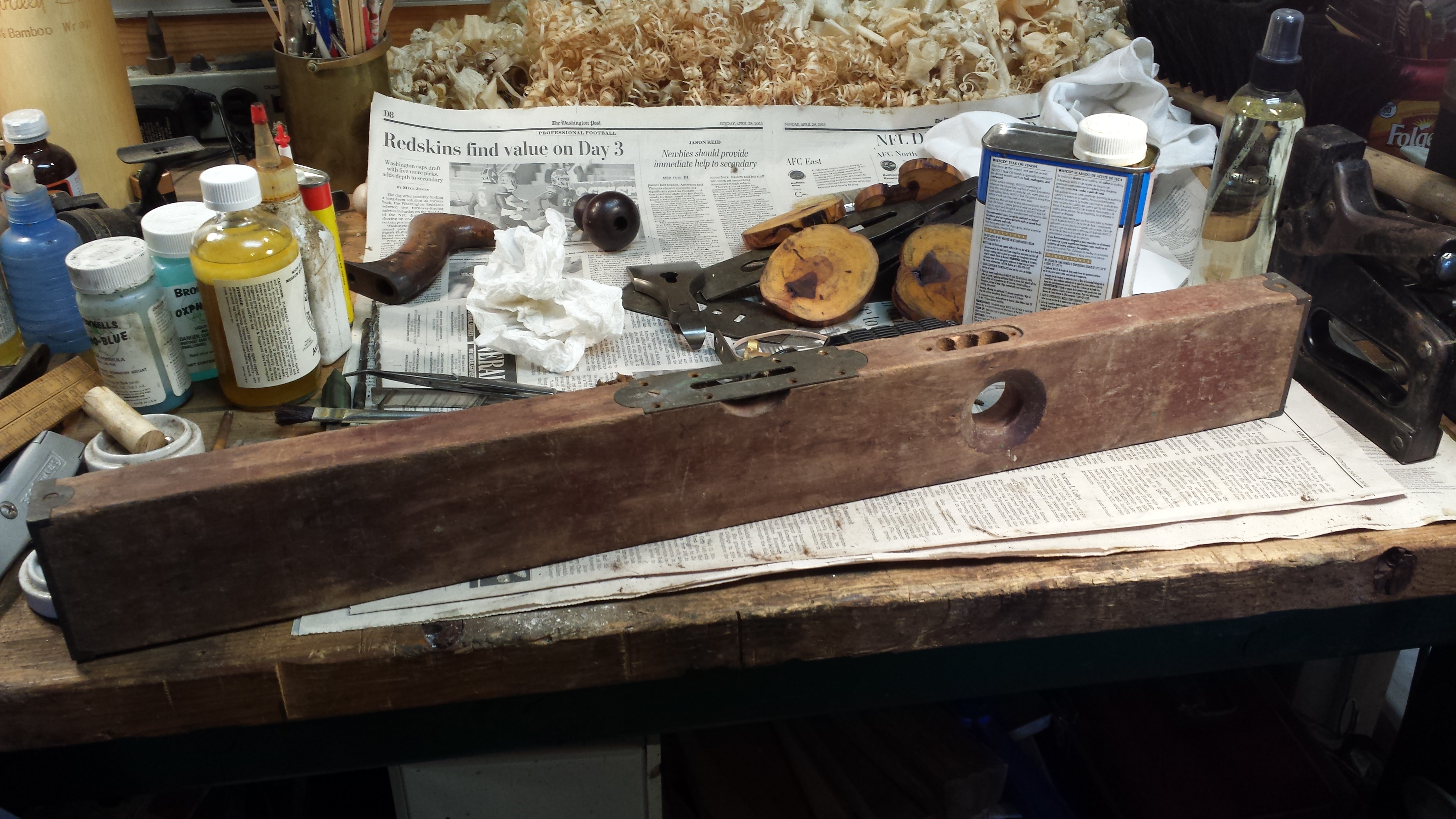
Level Pre-Restoration

My dad’s 1890s vintage Stanley no. 3 Level, partially disassembled

I disassembled and removed all the hardware to better evaluate what needed to be done in terms of cleanup, and to assess the broken plumb vial.  After cleaning the rust off all the screws and the vial adjustment mechanisms, I cleaned the crud off the brass plates and end caps.  I never polish old brass hardware, but I decided in this case to clean off most of the oxidation in order to better see the center scribe line.

With the hardware cleaned up, I moved on to the wood.  Despite its condition, there were numerous paint specks and splatters from years of use that I wanted to protect.  The wood itself is evidently cherry.  I cleaned it lightly with Kramer’s Blemish Clarifier to remove any loose dirt and crud.  I then applied 6 or 8 applications of Kramer’s Best Antique Improver, which I’ve written about before.  It’s great stuff, all natural (no petrochemicals), and restores life to finished and unfinished wood.

In the meantime, I went to work sourcing a proper replacement vial.  I preferred to keep it as close to original as possible, so new acrylic vials were out of the question.  I found a few glass vials for sale on eBay, but the prices were absurdly high.  So, I started trolling for a suitable “donor” level of approximately the same vintage.  It took 2 or 3 weeks, but I finally found one for under $10 that had the plumb vial intact.  When it arrived, I was surprised to find the condition actually better than the photos reflected.  I actually felt a little guilty stripping it of one of its parts.
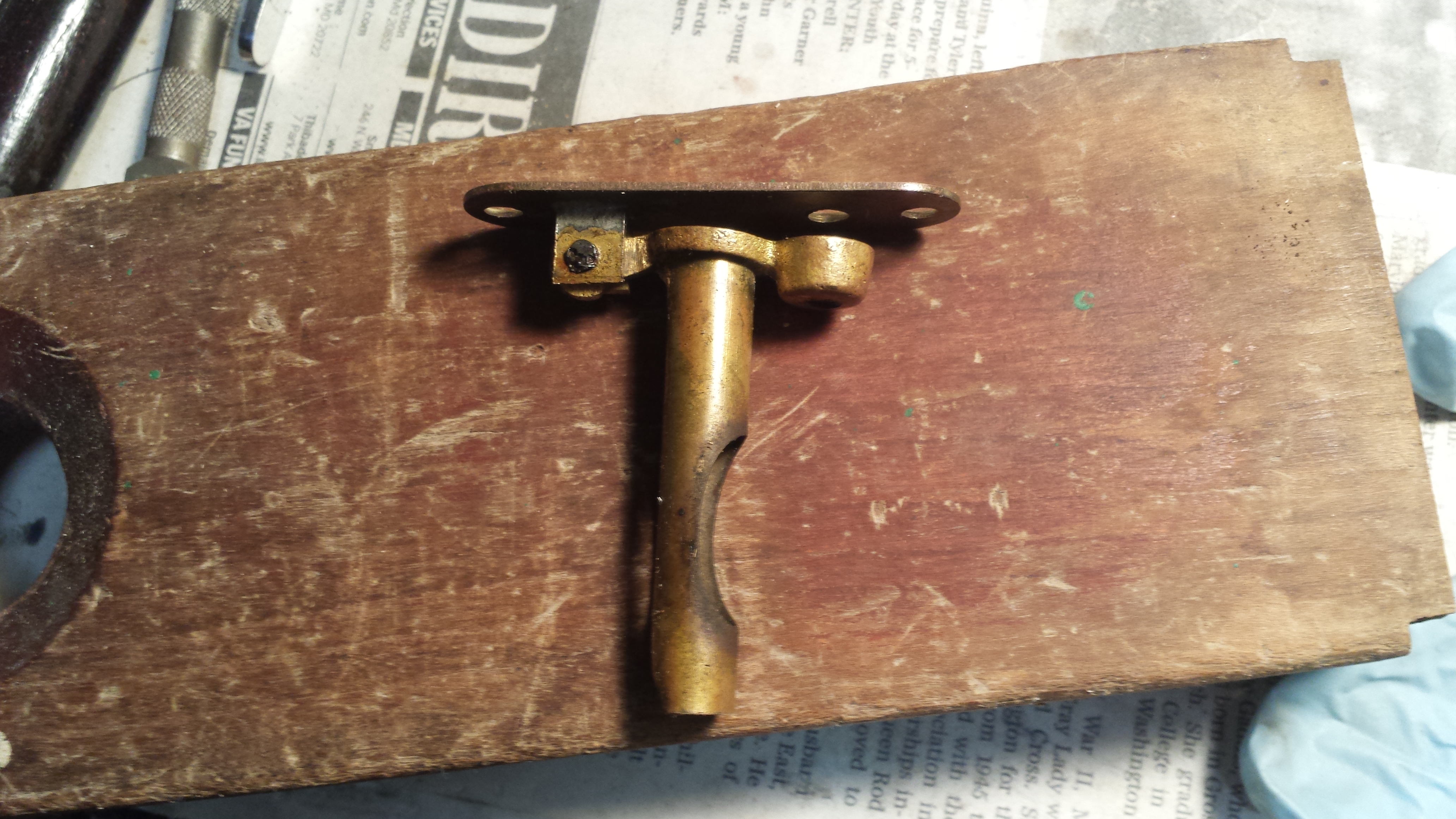
Plumb Vial Before Repair

Plumb Assembly Before Vial Replacement

Now if you’ve never replaced a vial in an old Stanley level, you might be surprised to learn that they used Plaster of Paris (or something similar) to cement the glass vial in the tube shaped holder.  This both held it in place and also protected the fragile ends.  Getting the vial out of the old plane was much easier than I anticipated.  Pulling the split holder tube open slightly, the vial and plaster slid right out in one piece.  Once out, the old plaster easily released from the glass vial.  The vial has a paper backing that wraps around the back side, but it isn’t attached.  So carefully removing that paper and setting it aside, a quick cleaning of the glass had it looking very much like new in short order.  Positioning the vial along with the paper backing into the assembly on my dad’s plane, I dabbed some plaster into place at each end and allowed it to dry.

I reattached all the hardware, and calibrated both vials using another level as a guide.  Completed, my dad’s old level is once again accurate and ready for the workshop.  You can just make out the replaced vial in the photo on the left.  Now, as to the donor level I bought, it’s still sitting here in need of a plumb vial.  There’s clearly something wrong with this scenario!

Complete Full ViewComplete Full View 2

“Excelsior” Profile Stanley Block Planes

Ever wonder about the origin of the word “Excelsior” as it refers to the body style on Stanley block planes?  Why Excelsior?  What does it mean?  Was it an official Stanley name or a term that has been applied in recent years?

Me too.

For anyone unfamiliar with the term, the “Excelsior” profile refers to the first body style used on Stanley block planes.  Dating from 1873 to 1898, the Excelsior profile differs from the later profile in that the “hump” in the cheeks is positioned more toward the rear of the plane.  After 1898 the hump was centered in the cheek profile and has the familiar milled Handi-grip indentions.  And yes, there was a very brief period of a few months in 1898 when the excelsior bodies also included the Handi-grip indentions.

Early Excelsior Profile Stanley 9-3/4 Type 1

Early Excelsior Profile Stanley 9-3/4 Type 1

The word Excelsior comes from the latin word excelsus, meaning meaning “ever upward” or “even higher.”  It is the origin for the word Excel, which obviously means to surpass in achievement.  However, more interesting and relevant for us, “Excelsior” is commonly defined as fine curled wood shavings used for packing.  Given that definition, it certainly makes sense that “Excelsior” was the name Stanley assigned to a line of block planes.

The earliest Stanley reference to Excelsior I could find is in the 1867 price list, which lists a “Patent Excelsior Tool Handle,” a wooden multi-tool handle that included 20 Bradawls and tools.  However, the multi-tool handle design more commonly referred to today as Excelsior was patented on March 19, 1867.  That patent design was awarded to Nathan S. Clement, and featured a different method of clamping the tool bits into the handle than the previous Stanley offerings.  As was often the case, the patent was eventually acquired by Stanley Rule & Level and incorporated into their product line, and was reflected in both wooden and the ornate iron handled multi-tool handles.

62938_IMPROVEMENT_IN_AWL_Clement 1867

Stanley also referred to their Bailey’s Patent Adjustable Block Planes as “Excelsior Block Planes” when they were introduced in 1873.   This term only applied to the adjustable mouth planes, such as the no. 9-1/2, no. 9-3/4, no. 15, etc.  The no. 110 and other non-adjustable planes had a different cheek profile, and were simply listed as Iron Block Planes in Stanley catalogs.

I did a little patent search sleuthing but could only find one reference that in any way tied in the term excelsior to hand or block planes.  In 1875, Albion K. Hall of Jackson, MI patented a plane specifically for making excelsior shavings.  However, I found nothing that tied him in any way to Stanley, so I assume there was no relationship between the two.

Stanley continued to use the Excelsior name for their multi-tools until 1902, and their planes until about 1898, when the profile was redesigned, moving the hump toward the center of the cheek.  Today, the Excelsior planes are attractive primarily to collectors.  While certainly usable, their castings tend to be thinner and more fragile than the later models, lending them better to display shelves than workbenches.  Either way, they remain, in my opinion, one of the more attractive plane designs ever devised.

The Excelsior line included the following planes:
no. 9-1/2
no. 9-3/4
no. 15
no. 15-1/2
no. 16
no. 17
no. 18
no. 19

***

Working Within the Limits of Tool Preservation

198 SB3 Type 9 Pre0I spent a long time researching and learning about tool preservation before I ever touched a plane. Even so, it was a couple or three years before I really settled into a comfort zone where the hands on experience I gained began to gel with the “book knowledge” I’d accumulated. For me, the greater appeal has always been geared more toward preservation than restoration (although I use the word restoration more often when casually talking about “cleaning up” a plane or tool). It’s probably a matter of semantics; I think most people equate restoration with refinishing, while preservation, by it’s very definition, speaks to preserving and sustaining. To me, that’s more accurate, and is a key part of my guiding philosophy and approach to tools.

It’s very easy for me to “go too far” when cleaning up a tool, to make it pretty vs. simply making it functional. My underlying intent is to preserve the character, finish, patina, etc. whenever possible. Dirt and rust are not sacred to me (as they are to some collectors), they are destructive elements of neglect. When I’m cleaning up a tool, I try to stay within the same boundaries that a woodworker of 100 years ago would have stayed within. He would have only been interested in preserving his tools, keeping them clean and in good working order, not making them pretty to sell on eBay. I constantly remind myself of that, not because I’m right and everyone else is wrong, but because it’s consistent and true to the values and parameters I defined when I started this venture. It’s my mission statement, if you will.

198 SB3 Type 9 Post7

***

Tune Your Block Plane Tonight

Following the popularity of the recent post, Tune Your Hand Plane Tonight, let’s now talk about block planes.  Much of the information will be the same, but block planes are different enough to warrant a dedicated set of instructions.  Besides, since there are probably more block planes owned today and sitting unused in garages and workshops than there are bench planes, they deserve a little love of their own.

As I’ve written before, I have a particularly strong affinity for block planes.  They are  the sexy two seater sports cars of the hand plane world – quick, nimble, and fun to handle.  But more than that, they are extraordinarily versatile and practical for many handy-man chores around the house, as well as indispensable tools in the wood shop.  Even the most ardent power tool user, and certainly the average homeowner, should have at least one or two block planes in his or her arsenal.

Keeping a block plane in good working order is quite easy.  Tuning one for optimal performance is a simple proposition that can be accomplished in an hour or so, if not less.  As I did with the bench plane instructions, I’m going to assume that your block plane is already in a mechanically functional condition and doesn’t require a full blown restoration.  For that level of detail, I recommend reading the posts under Preservation on the menu bar at the top of the page.  Since there are multiple mechanical styles and configurations of block planes, I’m going to try to keep it fairly generic, so you may need to interpolate for your specific plane.

Step 1 – Pour Drink of Preference

High-West-WhiskeyFor working on block planes, let’s go with something a little more exotic than the bourbon we enjoy with our bench planes.  I recommend Rendezvous Rye from the High West distillery.  It is… complex and superb.  Of course, what you drink is up to you, but moderation is certainly recommended, for while you won’t be working with electrically powered tools, you will be handling very sharp objects.  (5 minutes)


Step 2 – Disassembly & Cleaning

064 SB9.5 -Type 18 Post8The second step is to completely disassemble your plane and clean all the parts.  Using screwdrivers of the appropriate size, remove all the parts – lever cap, cap bolt, lateral lever, eccentric lever, adjustment screws, knobs, etc.  If you’re not completely familiar with what and where everything goes or are worried you might have trouble putting it all back together, take before pictures or notes.

Once disassembled, brush off all the sawdust and dirt.  If the filth is excessive, use a toothbrush and orange degreaser (available at the hardware or grocery store).  Also take a few minutes to clean the threads and slots on all the screws and bolts.  I use a small wire bristle brush with a little turpentine or light penetrating oil like WD-40. Once cleaned, wipe them down and set them out of the way so they don’t attract grit.  (10 minutes)

Step 3 – Hello Froggy

160 SAR5306 Post7Unlike frogs on bench planes, the frogs on block planes are usually fixed platforms cast into the body of the plane.  The top of the frog provides a small platform for the iron to sit, while the flat area behind the mouth offers support near the cutting edge.  Both surface areas should be clean of dirt and debris.  A toothbrush or brass bristle brush with degreaser works well, although you can also use WD-40 or turpentine.  The face of the frog is one of the more critical surfaces of the plane.  Once clean, fit the iron against the frog and verify that it sits flat and securely with no wobble.   You don’t want any wiggle or movement, so any high spots or irregularities in the casting need to be carefully filed or sanded flat.   (5-15 minutes)

Step 4 – Adjustimability of the Mouth

165 SB9.5 Type 12 Post7Many “premium” models of block planes feature an adjustable mouth opening.  This typically means the front section of plane’s sole is a separate piece than can be positioned toward the toe (thus opening the size of the mouth) or closer to the iron (closing the size of the mouth opening).   It is necessary to periodically remove this piece to clean out sawdust that has accumulated, and to clean and lubricate the tracks upon which the plate rides.  If it doesn’t adjust easily forward and back, it needs attention.

Since you’ve already disassembled the plane, make sure both the plate itself and the receiver in which it sits are both clean of debris.  Brush the edges of the plate and tracks of the receiver with a brass or wire bristle brush lubricated with light oil or turpentine.  Fit the plate in place and verify that it moves fairly freely.  It is not normally necessary (nor desirable) to sand the edges of the plate to make it move more easily, although this is sometimes necessary if the plane is vintage and the plate a replacement.  If you decide metal removal  is absolutely necessary, be careful and go very slow.  You can’t un-sand.  (5-15 minutes)

Step 5 – Inspect the Sole

165 SB9.5 Type 12 Post5Take a look at the sole (bottom) of the plane.  Inspect for dents or dings with raised points around the edges that might dig into your wood surface when planing.  If you find any, carefully file them flat with a mill file, followed by a little 220 grit sandpaper.  Unlike bench planes, which have a lot more surface area, flattening the sole of a block plane is a relatively painless process.  Although not usually a critical requirement, flattening the bottom will often provide superior results in use.

First, temporarily re-install the iron and lever cap and tighten to normal pressure.  This ensures the body will be under the same stress (and any possible distortion) as when in actual use.  Working against a dead flat substrate such as a granite sharpening block or the iron bed of a table saw,  start with 60 grit and go through progressively finer grits until you are satisfied that the toe, heel, and areas just in front of and behind the mouth are all completely flat and smooth.  I usually stop with 320 grit.  Aluminum Oxide sandpaper is my preference. If you don’t want to invest in a granite sharpening block, granite floor tiles from your local home center are just the right size and cost around $5 each.  (30-45 minutes depending)

Step 6 – Time to Sharpen

Sharpening SetupYes, sharpening is the step everyone loves to hate, the step that prevents so many people from ever trying a hand plane.  The trick is not to wait until you need to use the tool.  Make time for sharpening in advance, and make a party out of it!  Okay , so maybe not a party, but there is something truly rewarding about getting an edge you can shave with.  It’s relaxing and I really do enjoy it.  Since this is not a sharpening tutorial, I’ll leave the particulars on methodology to another post or reference.  But if you do nothing else, take the time to put a keen edge on your plane’s iron.  A 25 degree bevel works perfectly on most block planes – both low angle and standard angle models.  The angle of the plane’s bed varies on these models, usually either 12 degrees for low angle planes or 20 degrees for standard angle planes.  Add the 25 degree bevel and you end up with a 37 degree low angle of cut, or a 45 degree standard angle of cut (same as bench planes).  Add a micro bevel if you want, and don’t forget to polish the unbeveled back edge. (30 minutes)

Step 7 – Lubrication

Pure Oil 1Lubrication is a good idea, but should be done sparingly since oil attracts dirt and grit.  I add just a drop of light oil to the threads of all the bolts and screws before re-installing them.  I also add a drop to all the moving/adjustment parts, but wipe them with a rag afterward so that only a light film is left.  They certainly don’t need to be dripping.

Some guys believe in waxing the sole.  Nothing wrong with that as long as you don’t use a silicone based wax.  However, I just wipe down all exterior surfaces with a little Jojoba oil for storage.  (5 minutes)

Step 8 – Assemble, Adjust, Cut

187 SB18 Type 14 Post1Time to put it all back together.  Re-attach the eccentric lever and front plate (if it has one), adjustment wheel, lateral lever, knobs, etc. and all related hardware.  Carefully put the iron and cap iron assembly in place being careful not to fould the newly sharpened edge, and install the lever cap.  It should lock down securely, but not so tight as to inhibit raising and lowering the iron.  Adjust the front plate (if it has one) forward or backward as needed for the type of planing you intend to do (again, see open vs closed mouth).  Once set, lower the iron into the mouth to take your first test cut.   All of your hardware and adjustment mechanisms should move freely and smoothly. (10-15 minutes)

Unless you run into an unexpected problem, the entire tuning and sharpening process can be completed in about 1 to 2-1/2 hours, and even quicker if you’re tuning a new plane or re-tuning a plane that has already been tuned or well cared for.  It’s easy, rewarding, and builds both knowledge and confidence in your ability to master hand and block planes.

***

Tune Your Hand Plane Tonight

Among the most frequent web searches that lead people to this site come from those looking for information on tuning a hand plane.  Admittedly, for those new to the craft, or at least new to using hand tools, the prospect of setting up and fine tuning a hand plane is daunting.  After all, the nomenclature of parts is bewildering, the functional mechanics are an exercise in geometry and physics, and then there’s that whole issue with sharpening.  It’s no wonder so many people would rather spend an evening prepping for a colonoscopy.

But yea I say unto you, fear not!  Tending to a neglected (or new) hand plane is both relaxing and rewarding, and in most cases takes just an hour or two.  Best of all, the gratification is instant, the rewards immediate.

Now in the interest of keeping things simple, I’m going to assume that your plane is already in a mechanically functional condition and doesn’t require a full blown restoration.  For that level of detail, I recommend reading the posts under Preservation on the menu bar at the top of the page.  I’m also going to focus solely on bench planes.  I’ll cover black planes in a later post.  For simple tuning in one evening, read on…

Step 1 – Pour Drink of Preference

PVW-trio-4What you drink is up to you, and moderation is certainly recommended, for while you won’t be working with powered tools, you will be handling very sharp objects.  I personally prefer a finer bourbon, perhaps Maker’s 46 or Elijiah Craig 18 year, or if I’m in a particularly festive mood, a little Jefferson Presidential Select 17 year or Pappy Van Winkle.  Either way, begin by putting on some relaxing music and have a drink.  (5 minutes)


Step 2 – Disassembly & Cleaning

Disassembled Plane, Ready for TuningThe second step is to completely disassemble your plane and clean all the parts.  Using screwdrivers of the appropriate size, remove all the parts, screw, bolts, washers, etc.  If you’re not completely familiar with what and where everything goes or are worried you might have trouble putting it all back together, take pictures or notes.  Or just pay attention; it’s not that complicated for heaven’s sake.

Once disassembled, brush off all the sawdust and dirt.  If the filth is excessive, use a toothbrush and orange degreaser (available at the hardware or grocery store).  Also take a few minutes to clean the threads and slots on all the screws and bolts.  I use a small wire bristle brush with a little turpentine or light penetrating oil like WD-40. Once cleaned, wipe them down and set them out of the way so they don’t attract grit.  (10 minutes)

Step 3 – Inspect the Sole

Stanley No. 7 Jointer PlaneTake a look at the sole (bottom) of the plane.  Put a straight edge against it if it makes you feel better.  Once you’ve convinced yourself that it’s flat enough (which it undoubtedly is), set it aside and have another drink.  Seriously, after owning hundreds and using dozens of planes over the years, I’m convinced it’s rare to come across one with a sole so warped, cupped, or bowed that it’s unusable.  If there are any dents or dings with raised points around the edges that risk digging into your wood surface, carefully file them flat with a mill file, followed by a little 220 grit sandpaper.  You can also use the sandpaper or steel wool to remove any heavy crud – I suggest lubricating it generously with WD-40, Mineral Spirits, or Turpentine.  Working against a dead flat substrate such as a granite or the iron bed of a table saw is recommended.  Go easy.  No need to overdo it; you just want it to be clean and smooth.  (5-30 minutes depending)

Step 4 – Address the Frog

Lap frog face on edge of stone to protect yokeFirst inspect the seat for the frog on the top side of the plane’s base.  This is the area of contact where the frog attaches to the body of the plane.  The mating surfaces must be clean and flat.   Use a toothbrush with the degreaser.  If there is stubborn crud to be removed, use a brass bristle brush.  If the crud is really bad, you can use a small steel brush, but be very careful to to damage the surrounding finish.  Mating surfaces on the frog itself should also be cleaned in the manner described above.

The face of the frog is one of the more critical surfaces of the plane.  It needs to be as flat as you can get it so the iron sits completely flush against.  You don’t want any wiggle or movement, so any high spots or irregularities in the casting need to be filed or sanded flat.  I go back to my granite surface and sandpaper for this.  Taking care not to damage the tip of the yoke that engages the iron and cap/iron, carefully sand the face surface of the frog until it is as flat as possible.  Change directions periodically to keep it even.  You only need to do enough to ensure the iron sits flat against it.  (15-30 minutes)

Step 5 – Polish the Cap Iron

Cap IronThe leading edge of your cap iron (also called the chip breaker) will need a little attention.  Flatten the leading edge of the cap iron where it contacts the iron so that it seats completely flush against it.  You don’t want any gaps that shavings can slip through.  While you’re at it, polish the top side of that leading edge as well (the hump) to make it nice and smooth.  Less friction makes the shavings pass over it more easily, helping to prevent clogs.   The smoother the better, but don’t obsess over this step.  (10 minutes)   

Step 6 – Sharpen the Iron

Sharpening SetupYes, I know, the step everyone loves to hate.  Even for me, it’s often a task that I procrastinate over, but once I get going, I actually enjoy it.  Since this is not a sharpening tutorial, I’ll leave the particulars on methodology to another post or reference.  But if you do nothing else, take the time to put a keen edge on your plane’s iron.  A 25 degree bevel works perfectly on bench planes; add a micro bevel if you’re into that, and don’t forget to polish the unbeveled back edge. (30 minutes)

Step 7 – Lubrication

Pure Oil 1Lubrication is a good idea, but should be done sparingly since oil attracts dirt and grit.  I add just a drop of light oil to the threads of all the bolts and screws before re-installing them.  I also add a drop to all the moving/adjustment parts, but wipe them with a rag afterward so that only a light film is left.  They certainly don’t need to be dripping.

Some guys believe in waxing the sole.  Nothing wrong with that as long as you don’t use a silicone based wax.  However, I just wipe down all exterior surfaces with a little Jojoba oil for storage.  (5 minutes)

Step 8 – Assemble, Adjust, Cut

Stanley Bailey no. 5, Type 17 - WWII VintageTime to put it all back together.  Re-attach the frog and all its related hardware first, but don’t tighten just yet.   Put the knob and tote back on if you took it off.  Carefully put the iron and cap iron assembly in place and install the lever cap.  It should lock down securely, but not so tight as to inhibit raising and lowering the iron.  Adjust the frog forward or backward as needed until the iron’s cutting edge is positioned appropriately for the type of planing you intend to do (see open vs closed mouth).  Once set, tighten down the frog and lower the iron into the mouth to take your first test cut.   All of your hardware and adjustment mechanisms should move freely and smoothly. (10-15 minutes)

Unless you run into an unexpected problem, the entire tuning and sharpening process can be completed in about 1-1/2 to 2-1/2 hours, and even quicker if you’re tuning a new plane or re-tuning a plane that has already been tuned or well cared for.  It’s easy, rewarding, and builds both knowledge and confidence in your ability to master hand planes.

***

Wait!  What about the tote and knob, you ask?  You can read all about their care and repair right here.

Millers Falls Plane Specifications

Specification charts for Millers Falls planes have now been added to the site under the Tools menu.  Included are charts for bench planes as well as block and specialty planes.  These charts provide Stanley equivalents where applicable.

There is also a bench plane conversion chart cross-referencing planes made by Stanley, Sargent, Millers Falls, and Record.  I plan to have additional information available in the near future, including comprehensive information on both Millers Falls and Sargent.  In the meantime, enjoy!

Millers Falls page
Bench Plane Specifications Chart
Block Plane Specifications Chart
Plane Cross Reference Chart

***

Stanley Type Studies and More Now Posted!

I’ve just about finished uploading the Bailey and Bed Rock type studies, specification charts, and block plane dating information to the site.  There’s a wealth of information here, both summarized and broken down in detail by the major individual components.  The Bailey and Bed Rock type studies are relatively easy to find elsewhere online, but you won’t find the specification charts or information on dating your block plane anywhere but here!

Look for more information like this coming to the site over the next month or so, including specifications, conversion charts, and type studies for other models and manufacturers including Millers Falls, Sargent,  and Record.

By the way, if you’re new to collecting, don’t miss the post on understanding type studies.  It takes some of the mystery out of the madness.

Specification Charts

Stanley Bailey Bench Plane Chart
Stanley Bed Rock Plane Chart
Stanley Block Plane Chart

Type Studies

Bailey Type Study
– Bailey Detailed Identification
Bed Rock Type Study
Block Plane Dating

Understanding Type Studies

***


Understanding Type Studies

Catalog Image of Stanley Bailey Smoothing Plane, c. 1880sLet’s be honest, Type Studies are confusing to a lot of people, especially those new to tool collecting. One reason for this is that by their very nature, Type Studies attempt to identify very specific points in time that correspond with transitions in the design and manufacturing process of tools made in the past. There are many problems with this.  First and foremost, manufacturers never imagined that anyone in the future might care about tracking changes in the evolution of their designs.  Subsequently, even veterans who know better sometimes lose sight of just how blurry those lines of delineation are along the historical manufacturing timeline.

The first thing to clearly understand is that Type Studies are a present day construct. They were not a production guide used by manufacturers to identify, notate, or track changes in design.  Stanley and their competitors didn’t follow Type Studies.  Why, you ask?  Because Type Studies didn’t exist at the time the tools were made.  Did you get that?  Type Studies are a present day guide.

It was not until the 1970s and ’80s that people really started thinking about collecting vintage hand tools. And it’s only in the last 10 or 15 years, when woodworking with hand powered tools has enjoyed a resurgence, that vintage tool collecting has started to explode in popularity.  The big name hand tool aficionados (Roger Smith, Alvin Sellens, Clarence Blanchard, and others) conducted extensive research, pouring over company records and old catalogs and detailing the physical variations of thousands of tools in order to begin piecing together timelines for various models.

These timelines, delineated by significant and important changes in the design and manufacture of a tool are referred to as Type Studies.  Different ‘Types’ within a Type Study refer to a defined period of manufacture in which a particular set of features was unique.  That said, the change from one Type to another doesn’t mean the entire tool was redesigned.  In fact, virtually all feature changes overlapped others, and a given feature or set of features might extend over several Types.  A good example can be illustrated with the lever caps used on Stanley’s Type 13-15 bench planes made between 1925 and 1932.  While the same design cap was used on all three types, there were other feature changes that delineate the three different date ranges on the Type Study time-line.

Summing it all up, here are five important confusion-busting facts about Type Studies that should provide clarity:

    1. Type Studies are modern-day timelines used to identify the age of a tool by referencing important changes in its design, manufacture, and physical characteristics.  Different ‘Types’ within a Type Study refers to a particular period of manufacture in which a particular feature or set of features was unique.
    2. Manufacturers didn’t adhere to Type Studies because Type Studies did not exist at the time.  They simply manufactured tools and made periodic changes to design and manufacturing processes, just like manufacturers today.  We identify those periodic changes in the Type Study, and subsequently assign ‘Types’ based on the time period in which they were made.
    3. Type Studies are not interchangeable.   They only apply to a specific model or series of tools.  Different tools and different lines will have different Type Studies.  For example, Stanley’s Bailey line of bench planes have a completely different Type Study from the Bed Rock series.   Some tools, like the no. 71 router plane, have their own individual Type Study.  Many tools have never been studied in depth and don’t have a Type Study at all.
    4. Type Studies are approximations.  The manufacturing timeline was constantly evolving.  Even when design changes were made, existing (old) stock parts were used until their supply was depleted before moving to new parts.  Therefore, the changeover of features sometimes took months or even years, resulting in multiple variations of the same product being released at the same time.  While Type Studies imply that these changes were aligned with a specific date or year, collectors need to understand that the transitions were more evolutionary than revolutionary.
    5. Type Studies are not all-inclusive.  With some manufacturers and some tools, and some tools made during certain periods, features and materials varied quite a bit.  A good example of this is Stanley’s offering of Bailey bench planes made during World War II.  Brass was in short supply, and subsequently, the so-called Type 17 planes made during the war years have a variety of inconsistencies.  Some had brass hardware, where others have steel.  Some have rosewood knobs and totes, while others have painted hardwood.  Some have frog adjustment mechanisms while others don’t.   All made during this period, however, are considered Type 17, regardless of features.

***

An Inexplicable Affinity for Low Angle Block Planes

Stanley no. 65, c. 1913-19 (Left), no. 65, c. 1904-13 (Center), no. 65-1/2, c. 1905-10 (Right)

There’s something inexplicably sexy about low angle block planes.  Arguably the more versatile of all the block planes, low angle blocks were not historically the best-selling models in the lineup.  Stanley, and their counterparts at Millers Falls and Sargent (among others), were relatively conservative in their low angle offerings, at least compared to the standard angle variants they made.

If you include their more exotic models, Stanley produced a total of just 8 different variations of low angle block planes:

Model Length Width Adj. Throat Trim
No. 60 6 inches 1-3/8″ iron Yes Nickel
No. 60 1/2 6 inches 1-3/8″ iron Yes Japanned
No. 61 6 inches 1-3/8″ iron No Nickel
No. 62 14 inches 2″ iron Yes Nickel
No. 63 7 inches 1-5/8″ iron No Nickel
No. 64 12-1/2 inches 2″ iron No Nickel
No. 65 7 inches 1-5/8″ iron Yes Nickel
No. 65 1/2 7 inches 1-5/8″ iron Yes Japanned

Setting aside the extraordinary no. 62 ‘low angle jack’ and its oddball (and extremely rare ) short-lived brother, the no. 64, which were only called block planes due the bevel-up orientation of their irons, we’re left with six contenders.  Let’s review them in order…

The no. 60 & no. 60-1/2

Stanley nos. 60-1/2 & 60

The 60 series of Stanley planes includes the no. 60 and the no. 60-1/2.  Both planes are identical in every way other than their trim.  The no. 60, introduced in 1898, featured nickel-plated trim, while the no. 60-1/2, introduced in 1902, had japanned trim.  Just to avoid any possible confusion, the beds were japanned on all Stanley planes.  Trim refers to the lever caps, which came nickel-plated on the no. 60 and japanned on the no. 60-1/2.  Likewise, the knobs and adjustment wheels were nickel-plated on both the no. 60 and the no. 60-1/2. [1]

The ‘Type 1’ version of the no. 60, originally introduced with a rosewood front knob and no adjustable throat plate, was updated in 1902 with a brass front knob and an adjustable throat plate with an upturned eccentric adjusting lever.  Iron width on these planes is stated to be 1-1/2 inches prior to 1913, but I’ve never seen an example of this.[2]  Every one of this vintage that I’ve owned has featured a 1-3/8 inch iron with the J trademark stamp, which is correct for the period and dates from prior to 1909 on block planes (as far as I can tell).

These are my favorites of the low angle block planes.  I prefer their smaller 6 inch length for trimming end grain, an application at which low angle blocks excel.  Additionally, since their beds are set at 12 degrees and their irons positioned bevel up, you have the flexibility of changing the bevel angle to affect a change in the angle of cut.  With its bevel sharpened at the standard 25 degrees, you get a 37 degree angle of cut (12 + 25 = 37).  However, you could reasonably sharpen the bevel at 33 degrees and get a 45 degree cut, the same as a standard angle plane.  With two irons sharpened at different angles, you could conceivably get by with just one block plane for both standard and low angle cuts.

A note of caution… low angle planes are a little more fragile than standard angle planes for two reasons.  First, the angle of the bed is much sharper, making the leading edge (back edge of the mouth) more prone to chipping and cracking, so go easy on them when planing.  Second, don’t tighten the lever cap too much.  It puts a strain on the threads of the depth adjustment mechanism at the rear when you adjust the iron depth.  If it’s too tight, those threads can strip.

The no. 61 & no. 63

Stanley nos. 61 & 63

Introduced in 1914 and 1911 respectively, it appears that neither the no. 61 nor the larger no. 63 were particularly successful for Stanley.  Very few folks were tempted to purchase a low angle plane without an adjustable throat, especially when that feature could be had for just a few pennies more.  Subsequently, their limited popularity constricted demand and production, and so they are fairly hard to find today.  While collectible due to their scarcity, users looking for a functional low angle block are far better off sourcing a no. 60 or 65 in good condition.

Ironically, these planes are virtually identical to the very first type no. 60 and no. 65, both of which were introduced in 1898 with a similar wooden knob and lacking an adjustable throat.  Why then, less than 10 years later, Stanley thought reintroducing this handicapped design under the model nos. 61 and 63 was a good idea is anyone’s guess.  Regardless, both the no. 61 and no. 63 are easily distinguished from the Type 1 no. 60 and 65 since their model numbers were cast in relief at the rear of the bed just below the depth adjustment knob.  Manufactured for less than 25 years, both planes were discontinued in 1935.

The no. 65 & no. 65-1/2

Stanley 1935 Catalog

The 65 series includes the highly regarded no. 65 and less common no. 65-1/2.  Measuring about 7 inches long with 1-5/8″ irons, these planes are the bigger brothers to the 60 series of low angle blocks.

Like the 60 series, the lineage of the no. 65 series is equally convoluted.  Introduced in 1898, the no. 65 was first offered with a nickel-plated hooded style lever cap, wooden front knob, and non-adjustable throat.  The first major change happened in about 1905 when the wooden knob was replaced with the same brass knob used on all the other blocks, and an adjustable throat was added.  The third major change took place around 1913 when the hooded lever cap was replaced with Bodmer and Burdick’s newly designed knuckle joint lever cap, the same that was updated on the no. 18 and no. 19 standard angle planes.  50 years later, in 1964, the lever cap was changed back to the hooded type found on the no.  9-1/2, before the plane was discontinued altogether in 1969.

Considered one of the best block planes Stanley ever made, the no. 65 is sometimes referred to as the ‘Cadillac’ of block planes by vintage tool enthusiasts today.  While I prefer the smaller no. 60, the no. 65 is indeed an exceptionally well designed plane and a pleasure to use, using the same care considerations noted above for all the low angle blocks.

The no. 65-1/2 version is a bit of an oddball, at least in my opinion, in that it retained the original japanned hooded style lever cap throughout its entire lifespan.  While I don’t see nearly as many of them as I do the more popular no. 65, they were certainly made for a very long time (1902-1950).

There appears to be some inconsistencies in some very reputable published references, which imply that the 65-1/2 was offered with nickel trim.  I don’t believe this was ever the case.  Stanley catalogs from back in the day all list the no. 65 as having nickel trim and the no. 65-1/2 with japanned trim. It’s a little hard to see, but click on the image above to view a page taken from Stanley’s 1935 catalog.  Center left on the page lists the no. 60-1/2 and no. 65-1/2 together, both with japanned trim.

_____________________________
1. Depending on the reference, it appears that Stanley might have used both polished brass and nickel-plated knobs and adjustment wheels at various times.  While it is very common for the nickel plating on these parts to be well worn, I’ve seen enough examples both with traces of nickel and others with no trace whatsoever that lead me to believe that Stanley wasn’t always consistent across models.

2. Walter, John, Stanley Tools: Guide to Identity and Value, 1996.

***

Tools shown in the photos were returned to functional condition by Virginia Toolworks using museum quality archival preservation techniques.  Sharpened and tuned for use, every tool is fully tested and adjusted until perfect.

Select the Best Bench Plane for the Job

Stanley Bailey no. 5-1/2, Type 11

Asking what size bench plane is the best to buy is sort of like asking what size drill bit you should use. It depends on what you plan to do with it. That said, while you probably need a full set of drill bits in with a wide range of sizes, you certainly don’t need to own every size bench plane that Stanley ever made. In fact, you can accomplish just about every job you’re likely to face with just three bench planes.  More important than focusing on a specific model number is gaining a basic understanding of what the planes do and how the various sizes differ.

Bench planes, whether made by Stanley, Millers Falls, Sargent, Union, Craftsman, Lie-Nielsen, or Veritas, etc., all do the same thing – they shave wood. Of course, while shaving wood is the functional process, making the wood surface flat is generally the object of the exercise. To that end, certain size planes are better suited for a particular step in that process than others.

The first thing to understand is that neither physical size nor Stanley’s related numbering system has any relevance to how the planes are used or in which order they should be employed. In Stanley’s bench plane numbering scheme, the smaller the number, the shorter the length of the plane, with a few ‘1/4’ and ‘1/2’ width variations thrown in for good confusing measure. So, their no. 1 plane is the shortest at just 5-1/2 inches, while their longest is the no. 8, at 24 inches. Note that this sequential logic only applies to their bench planes, not their block or specialty planes.

Grouping them by function is a different matter, and far more relevant in understanding how to use them. Bench planes can be separated into three functional groups:

  1. Fore planes
  2. Try planes
  3. Smoothing planes

1. Fore Planes – For Rough Preparation

Stanley no. 5 Fore Plane, Type 11

Fore planes are those ranging from approximately 14 inches to 18 inches in length. In the Stanley bench plane assortment, these include the nos. 5, 5-1/4, 5-1/2, and 6. The term ‘Fore’ dates back several hundred years and is generally assumed to be a contraction of ‘Before’ and interpreted as the plane used first in flattening a surface. “It is called the Fore Plane because it is used before you come to work either with the Smooth Plane, or with the Joynter.” [1]

As the first plane one would use in preparing a surface, the Fore plane takes the most aggressive cut, removing rough saw marks and leveling out low and high spots, etc. The iron is sharpened with a significant camber, or curvature to the cutting edge, with as much as 1/16″ to 1/8″ difference between the center and the edges. This removes the most waste, but subsequently leaves the surface of the wood with a scalloped finish.

While either the no. 5 or no. 6 will do, I prefer the size and greater versatility of the no. 5. Rough planing is a very physical activity, and the lighter weight of the no. 5 makes it less fatiguing to use. It’s smaller size also makes it more versatile for a variety of other day to day planing jobs. If you’ll use your Fore plane exclusively for prepping tabletops or dresser carcasses, the no. 5-1/2 or no. 6 would be fine choices. But the no. 5 is, in my opinion, the most versatile of the group and the plane I use most often.

Those of you paying attention are no doubt asking, “If the no. 5 is a Fore plane, why is it so often referred to as a ‘Jack’ plane?” Indeed, the nomenclature pond is very murky at times. While no one knows for sure, most people guess the nickname ‘Jack’ originated from the term ‘Jack of all trades’ and refers to the versatility of planes measuring about 14 inches in length. And versatile they are; the no. 5 was by far the best selling size plane Stanley or its competitors ever made. Historical texts seem to support this moniker as well, as references to Jack planes extend back to at least 1703 (Moxon). Regardless, its length puts it in the Fore plane category, and its versatility assures it a place on the workbench.

2. Try (or Jointer) Planes – For Refining the Surface

Stanley no. 7 Jointer Plane, Type 11

Try planes, more commonly known as Jointer planes, are those over 18 inches, and are most commonly 22 to 28 inches. Stanley’s offering of Jointer planes are the no. 7 and no. 8, measuring 22 inches and 24 inches respectively.

As the name implies, a Jointer plane excels at truing the edges of long boards that will be glued together to make table tops, shelves, and carcasses. But its value and place on the workbench isn’t limited to edge work. The Try, or Jointer, plane is used to flatten and refine the surface left by the Fore plane. Its extra length allows it to true large flat surfaces without riding up over the peaks or dipping down into the valleys created (or left uncorrected) during the initial surface preparation.

Despite its heft, the Jointer should be considered a precision tool. The iron should be sharpened with a slight camber (or perhaps none at all if used exclusively for edge work), and the frog typically adjusted with a fine set for thinner shavings than the Fore plane. Working both across the grain and in all directions, the Try plane leaves a perfectly flat surface that requires only final touch up with the Smoothing plane.

Your choices between the two standards, nos. 7 and 8, are really a matter of personal preference. In this case, Newton’s laws of motion lend a helping hand.  The greater heft is actually a benefit, in that once you get it moving the additional mass helps keep it going with less effort. That said, the no. 8 is quite a beast, and my personal preference is for the lighter and shorter no. 7, which I find easier to manage.

3. Smoothing Planes – For Final Finishing

Stanley no. 4 Smoothing Plane, Type 19

Smoothing planes include the shorter planes in the lineup, those 10 inches or less. Stanley made a number of planes in this range, from the tiny no. 1 to the most popular no. 4 and its wider sibling, the 4-1/2.

The Smoothing plane is the final plane used prior to applying the finish. Executed properly, there should be no need for sandpaper. Used primarily with the grain, the Smoothing plane is normally sharpened with just the slightest camber or left straight with its corners eased to prevent them from digging in or leaving tell tale ‘lines’ along the edge of the cut. The frog is adjusted with a closed mouth for the finest of cuts, and the shavings produced are tissue thin, ideally produced from long strokes covering the full length of the wood. Aside from perhaps a little hand scraping here and there, the surface left by the Smoothing plane should require no further treatment. In fact done correctly, sanding would actually diminish the quality of the surface left by the Smoother.

More so than with the Fore and Try planes, the choice of which size Smoother is really a matter of and comfort and the scale of your work. All of them will do a comparable job, although the nos. 1 and 2 are really only suited for very small surfaces (and very small hands). The no. 4 is considered the most versatile size, and the one I use most often. However, I do have a smaller no. 3 and a wider no. 4-1/2 that I reach for, depending on the size of the project. But since the point of this article is to identify the three core bench planes you’ll need for woodworking, the no. 4 is probably the best overall size choice for a single Smoothing plane for most people.

Understanding and applying the concepts of the three steps is far more important than knowing which plane to choose. Depending on the size of your projects, you may want to scale up or down all three tool choices.  For most woodworkers, however, I recommend the vintage Stanley no. 5 Fore plane, the no. 7 Try/Jointer plane, and the no. 4 Smoothing plane, or the comparable size equivalent from one of the other major manufacturers.

I will conclude by pointing out the obvious – if you’re starting with dimensional lumber from your local home center or planing mill, you can certainly skip the Rough step altogether, and may be able to skip the Refine step too, getting by with just a little Smoothing. I can promise this, once you get the hang of a Smoothing plane, you’ll never want to pull out your random orbit sander again.

 ***

For more detailed information on the three step process using hand planes, I highly recommend you check out Christopher Schwarz’s outstanding Course, Medium, and Fine, available on DVD.

Tools shown in the photos were returned to functional condition by Virginia Toolworks using museum quality archival preservation techniques.  Sharpened and tuned for use, every tool is fully tested and adjusted until perfect.

____________________________________

1. Moxon, Joseph. Mechanick Exercises. London, 1703.